Repair or Replace Your Deck? How to Tell
How to check the frame under your deck, what can be repaired, when a rebuild is the better buy, and when a repair needs a permit.
Look under the boards before you decide. If the posts, footings, beam, joists and the ledger at the house are solid, the deck can usually be repaired: new boards, new stairs or a new railing on the frame you have. If the frame is soft, the footings have moved or the ledger is failing, rebuild it. New boards on a failing frame only hide the problem for a season or two.
Boards almost always look worse than the rest of the deck. They take the sun and the rain. The frame sits in the shade underneath, and that's where the decision gets made.
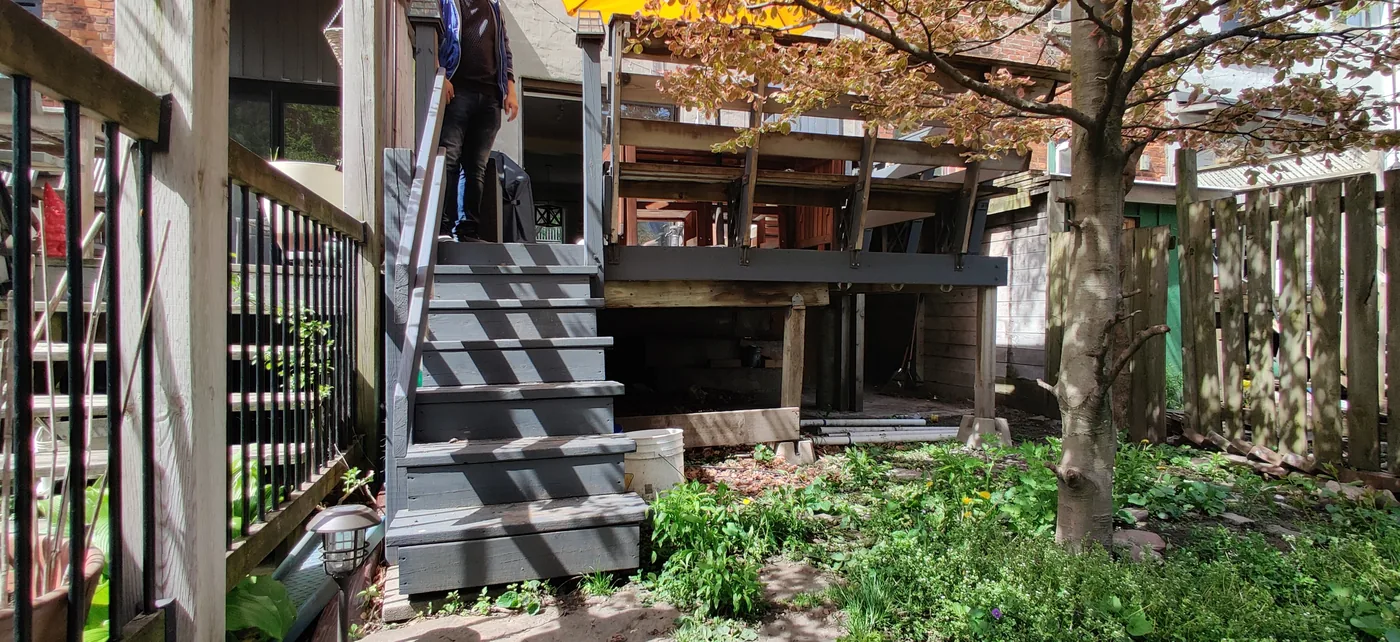
The frame decides
A deck is two jobs stacked on top of each other. The structure is the footings, posts, beam, joists and the ledger that ties the deck to the house. The surface is the boards, stairs and railing. The surface wears out first and is the cheaper part to replace. The structure holds people up, and it's the part you can't fix later without taking the deck apart.
So the question isn't how bad the boards look. It's whether the frame underneath has years left in it.
How to check your deck
Take a flashlight and a flathead screwdriver. The North American Deck and Railing Association (NADRA) says that if the tip sinks in about 6 to 13 mm (1/4 to 1/2 in), or the wood feels soft and spongy, decay may be present. Check:
- The ledger, where the deck meets the house. NADRA says it shouldn't be held on with nails alone, and the flashing over it should be sound and firmly in place
- The joists from underneath, especially near the house and at the ends: soft spots, cracks or sagging
- The beam, and how it sits on the posts
- Each post at the base, and the footings. A footing that has lifted, or a deck that has gone out of level, usually means frost has moved it
- Every railing post. Push hard at the top. It shouldn't move
- Stair stringers and risers, which should be firmly attached and not decayed
- Fasteners and hangers, looking for rust and popped nails
Trex gives the same advice in its resurfacing guide: rusted framing hardware should be replaced, and decayed or cracked framing has to be replaced before new boards go on.
NADRA's checklist is written for homeowners and says it doesn't establish code compliance. If you find soft framing or a deck that moves, have it looked at before it gets heavy use again.
Repair or rebuild: what each problem usually means
| What you find | What it usually means |
|---|---|
| Split, cupped or soft boards, frame solid | Repair. Replace the bad boards, or resurface the whole deck |
| Railing posts that move or are rotted at the base | Repair. New posts and rails, fastened properly to the frame |
| Soft stair treads or stringers, frame solid | Repair. Rebuild the stairs |
| A few soft or cracked joists, the rest solid | Repair. Replace those joists before new boards go on |
| Posts rotted at the base, or footings heaved | New posts and footings at least, and often a rebuild |
| A rotted ledger, or water getting into the house wall | The house connection has to be rebuilt, often along with the deck |
| Rot through most of the frame, or a deck that sways when you walk on it | Rebuild |
Two decks, two answers
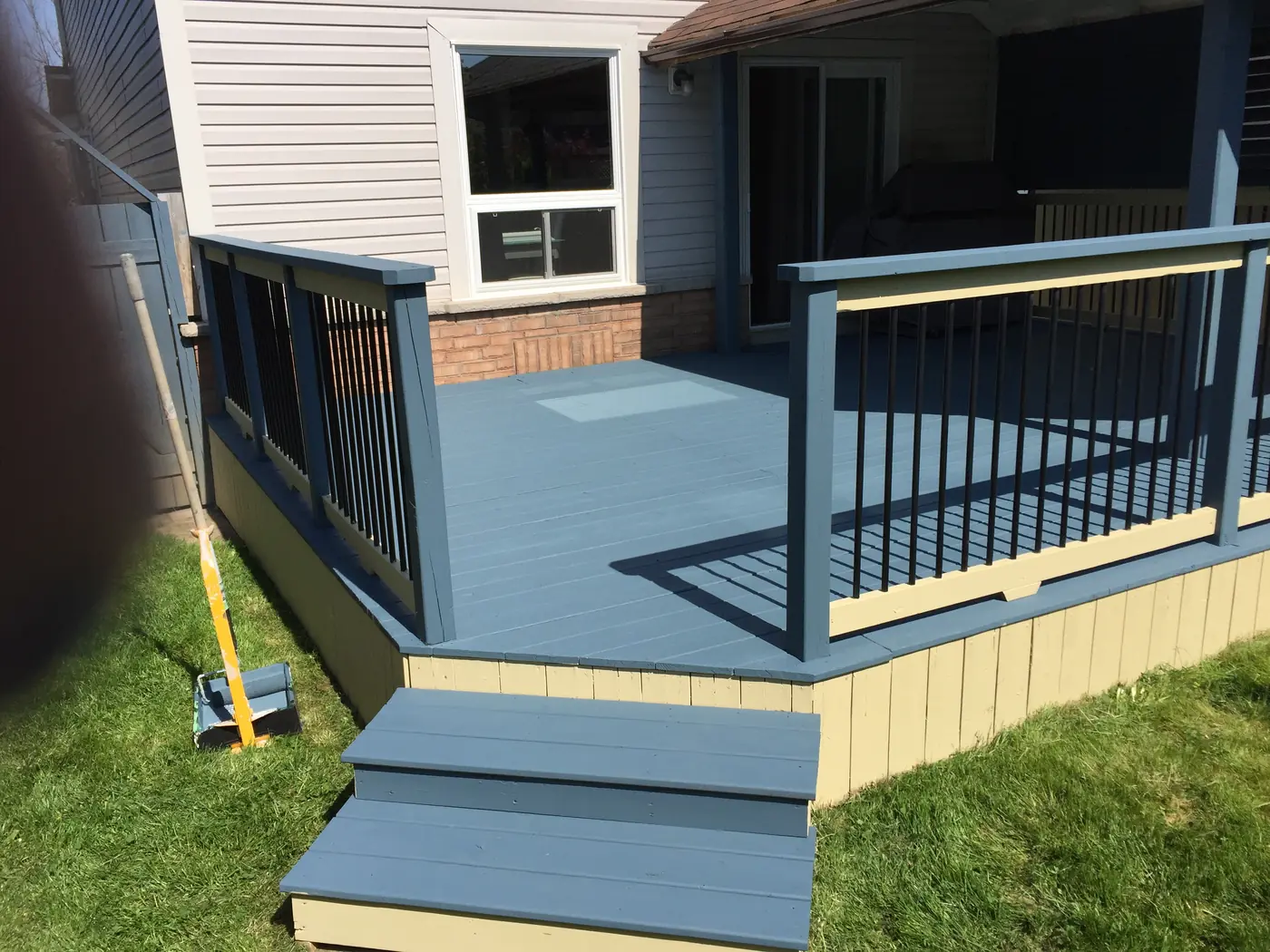
On a deck repair in Stouffville, boards had split right through and a corner railing post had rotted away at its base. From the yard it looked finished. We pulled the bad boards and checked the framing and the ledger, and the structure held. So it became a repair: new boards and railing where they'd gone, then a full repaint so the new and old boards read as one deck.
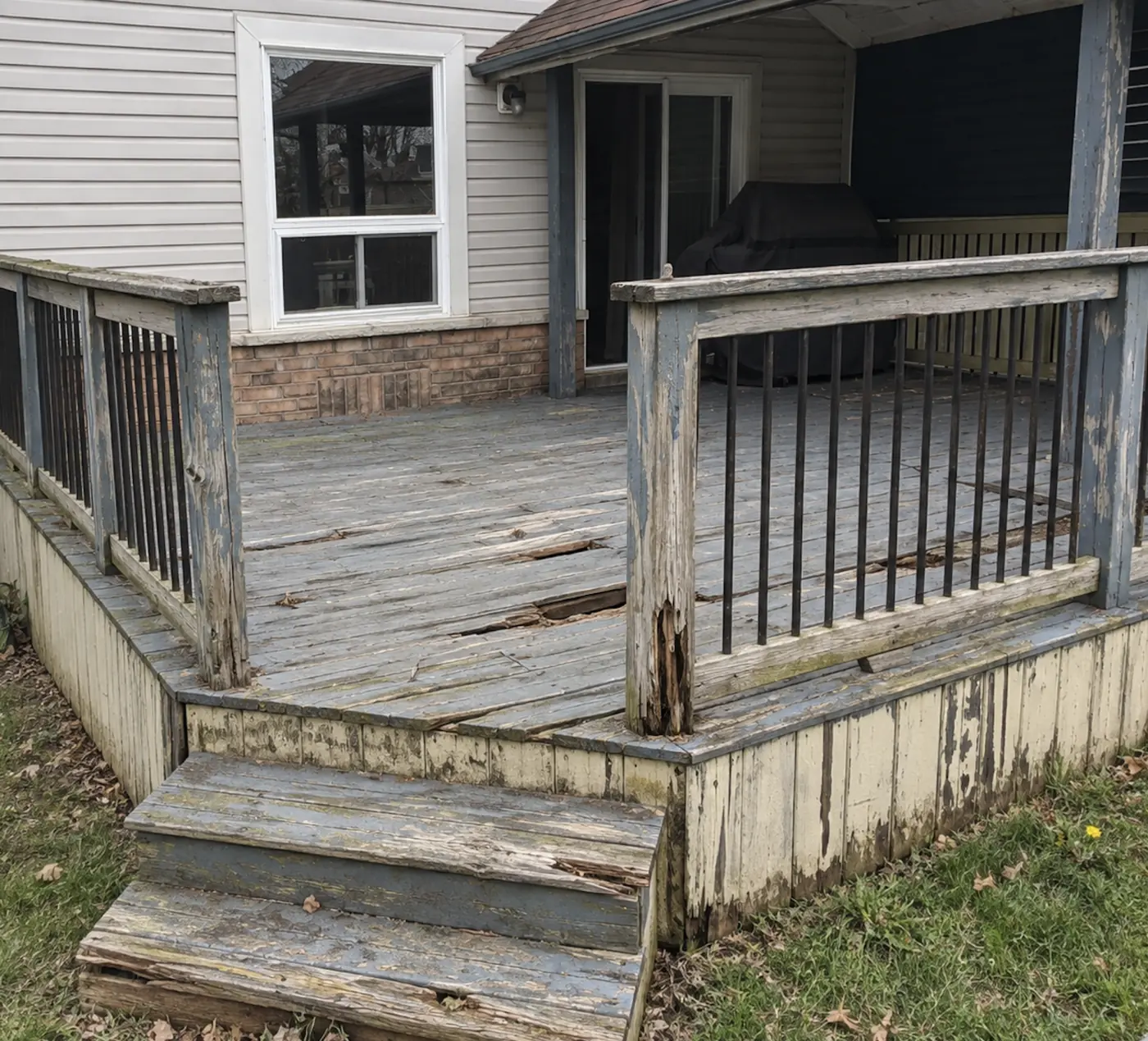
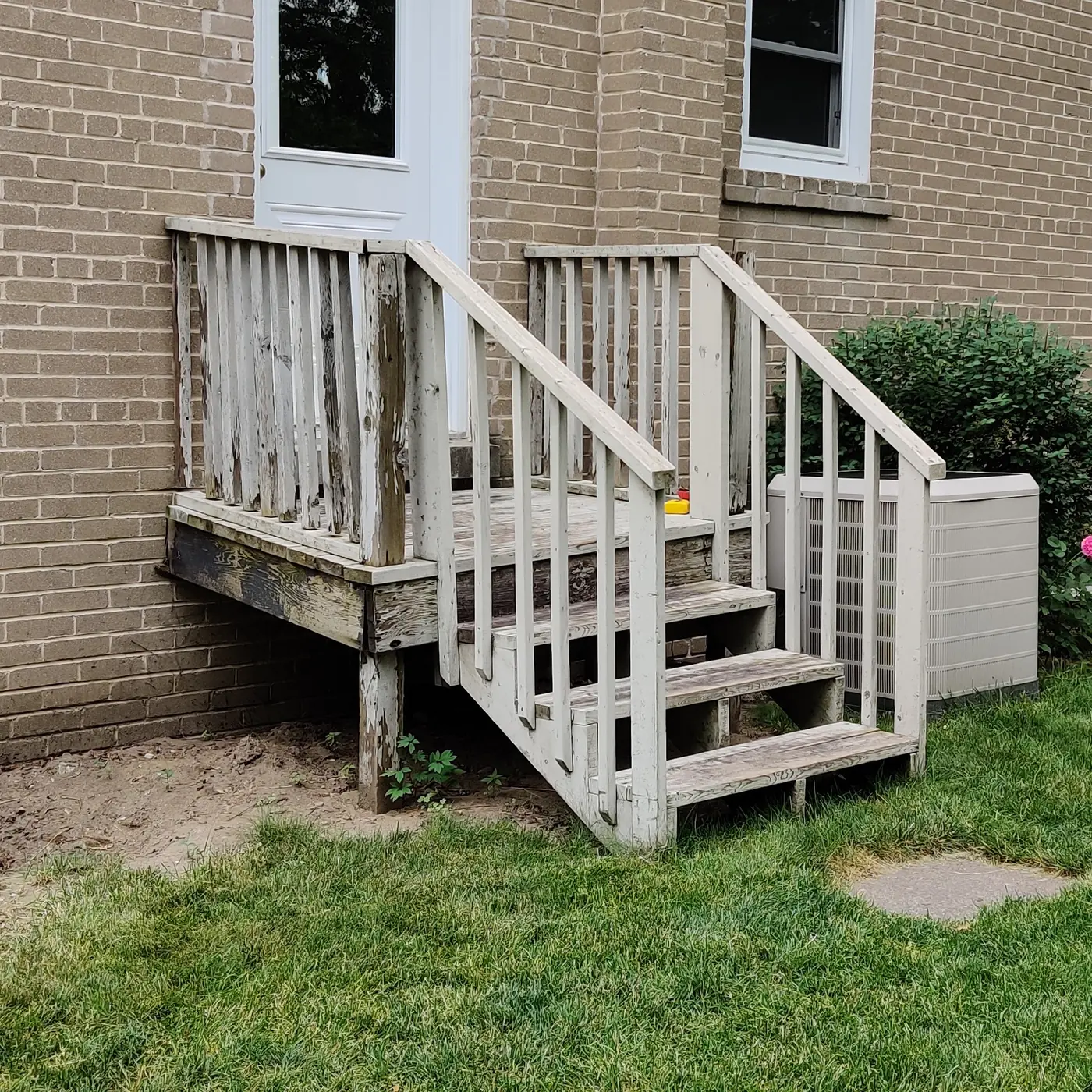
In Whitby, the answer went the other way. The entrance deck had been painted for years, the posts had gone at ground level, the stair stringers were soft and the whole thing moved underfoot. With the posts and stringers gone there was nothing sound to attach new work to. It came out to the ground and was rebuilt on new posts and concrete footings.
Resurfacing: new boards on the old frame
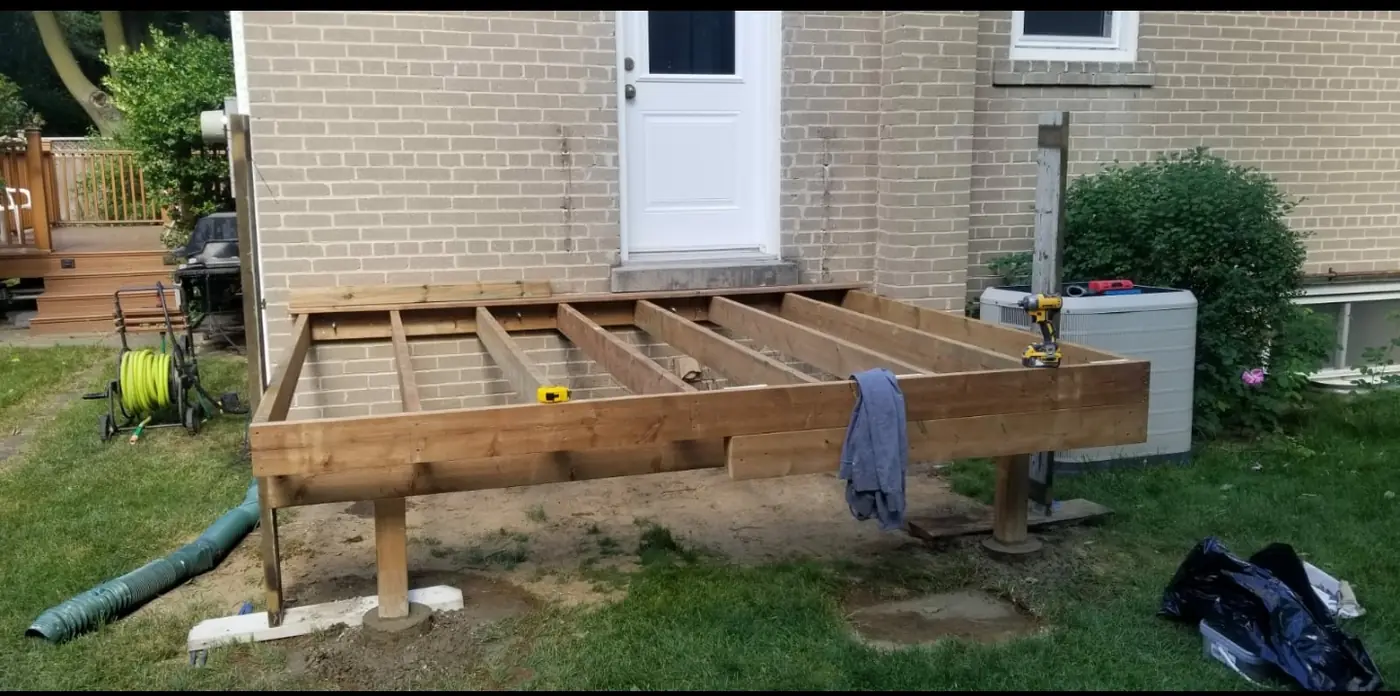
Resurfacing keeps the frame and replaces the surface. It works when the frame passes the checks above, and it's the usual way to put composite on an old wood deck.
Two things to know first. The old boards come off. TimberTech says not to lay new boards over old ones, because water collects between them and rots the wood. And composite needs joists closer together than many wood decks were built with. TimberTech says joist spacing for its boards should never go over about 400 mm (16 in) on centre, and about 300 mm (12 in) when the boards run on a diagonal. If your joists are farther apart, extra joists go in first. Our composite vs wood guide covers the rest of that choice.
Ask one more question before you resurface: will the frame last as long as the new boards? Composite on a tired frame puts the money into the part of the deck that wasn't the problem.
Does a deck repair need a permit?
Replacing boards on the same frame usually doesn't. Structural work can. In Toronto, building a deck more than 60 cm (24 in) above the ground needs a permit, and the city's list of work that doesn't need one says nothing about deck repairs. Pickering's deck guide says a permit may be required even to rebuild or repair a deck at the same size, and that the work may have to meet newer code requirements.
So before new posts, footings, beams or a ledger go in, check with your city's building department. A rebuild is also when an old deck gets brought up to today's rules, like a guard on any deck more than 600 mm (24 in) off the ground. See our Toronto deck permit guide and the railing height guide.
What each path costs
Repairs are priced per job, because two decks with the same problem rarely need the same fix. For a rebuild, our deck cost guide has the ranges, installed and before HST. A new 12 x 16 ft (192 sq ft) pressure-treated deck runs $5,760 to $10,560, or $10,560 to $18,240 in mid-range composite. Removing the old deck adds $500 to $2,500, and stairs on a raised deck run $3,000 to $8,000 or more.
If a repair would cost close to a rebuild and the frame is already old, the rebuild is usually the better buy. The extra money gets you new footings and a new frame.
When to do it
Boards, railings and stairs on a sound frame can be repaired in cool weather. New footings are harder to set once the ground freezes, so book structural work before the deep freeze. New footings mean digging, so locates come first through Ontario Dig Authority (formerly Ontario One Call). Our deck footing depth guide explains how deep they go, and the winter deck guide has a fall checklist.
See our deck repair page, or send us photos of the top, the stairs and underneath the deck, and we'll tell you whether it's a repair or a rebuild.
Sources: NADRA, Deck safety checklist; Trex, How to resurface a wood deck with Trex composite decking; TimberTech, Deck joist spacing and blocking and Installing composite decking over wood; City of Toronto, When do I need a building permit; City of Pickering, Deck construction guide. Checked October 2026.
Keep reading
Deck cost guide
Installed prices per sq ft by material, plus railings and stairs.
Learn moreFence cost guide
Installed prices per linear foot by fence type, plus gates.
Learn moreHow long a fence lasts
What wears out first on each fence, and what warranties cover.
Learn moreToronto fence permits and exemptions
When a Toronto fence needs a permit, and how exemptions work.
Learn moreQuestions
How do I know if my deck needs to be replaced?
Can I put composite boards on my old deck frame?
Do I need a permit to repair my deck?
Is it cheaper to repair or replace a deck?
Tell us about your deck or fence
Send a few photos and rough measurements. We'll come back with next steps and a time to see the site.