Glass vs Aluminum Deck Railings: Cost, View and Upkeep
What each one costs in the GTA, what you see through it, how much cleaning it takes, and why many decks end up with both.
For most GTA decks, aluminum pickets are the better buy, and glass is worth the extra money on the side you look out from. That's why many of our clients end up with both: glass facing the yard, aluminum on the sides and down the stairs.
Glass in aluminum posts runs about $120 to $200 per linear foot installed, against $85 to $140 for aluminum pickets. Both pass the Ontario Building Code when the system is engineered and the posts are fastened properly. What separates them is the view, the cleaning and the cost on stairs.
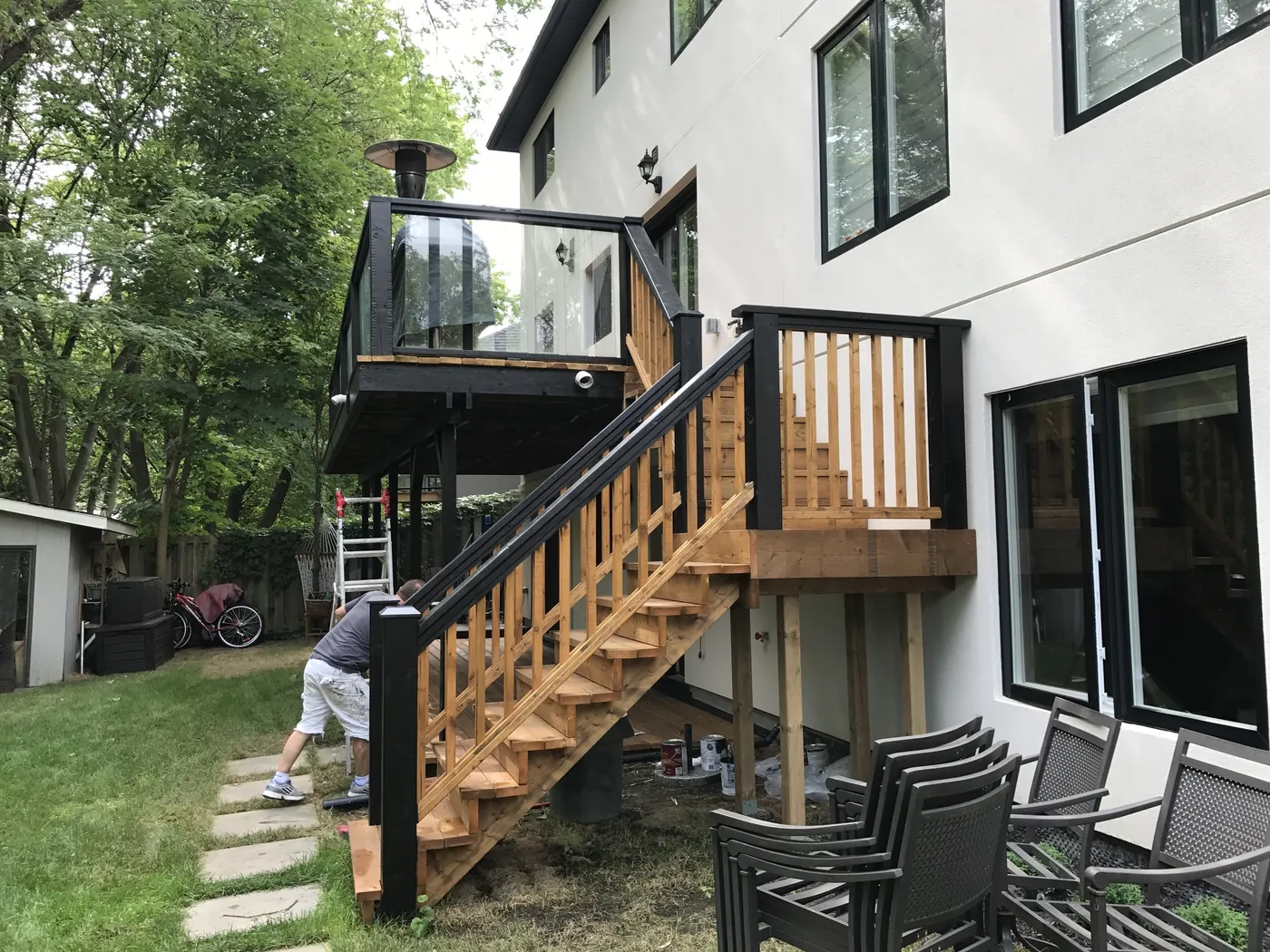
Side by side
| Aluminum pickets | Glass | |
|---|---|---|
| Installed cost | $85 to $140 per linear ft | $120 to $200 in posts, $200 to $400 frameless |
| The view | Pickets break it up, most of all when you're sitting | Open between the posts. Frameless has no posts |
| Cleaning | Hides dirt. A wash twice a year | Shows water spots, pollen and nose prints |
| Stairs | The usual choice | Costs the most here |
| Privacy | A little | None with clear glass |
| Birds | No issue | Collision risk near trees and ravines |
| Inspection | Engineered system, posts blocked into the frame | Same, plus marked safety glass |
What each one costs
These are installed prices before HST, from our deck cost guide. For a 40 ft run of railing:
- Aluminum picket railing: $85 to $140 per linear ft, about $3,400 to $5,600
- Glass in aluminum posts: $120 to $200 per linear ft, about $4,800 to $8,000
- Frameless glass, 12 mm (1/2 in): $200 to $400 per linear ft, about $8,000 to $16,000
- Railing on stairs: add 25% to 40%, whichever one you pick
- Taking off the old railing: $5 to $12 per linear ft
Splitting that 40 ft into 24 ft of glass in posts facing the yard and 16 ft of aluminum on the sides comes to about $4,240 to $7,040, against $4,800 to $8,000 for all glass. The bigger saving is on the stairs, where the 25% to 40% add-on lands on the higher glass price.
Height, corners, gates and tight access move the number. Your quote gives one price once we've seen photos or the deck.
The view
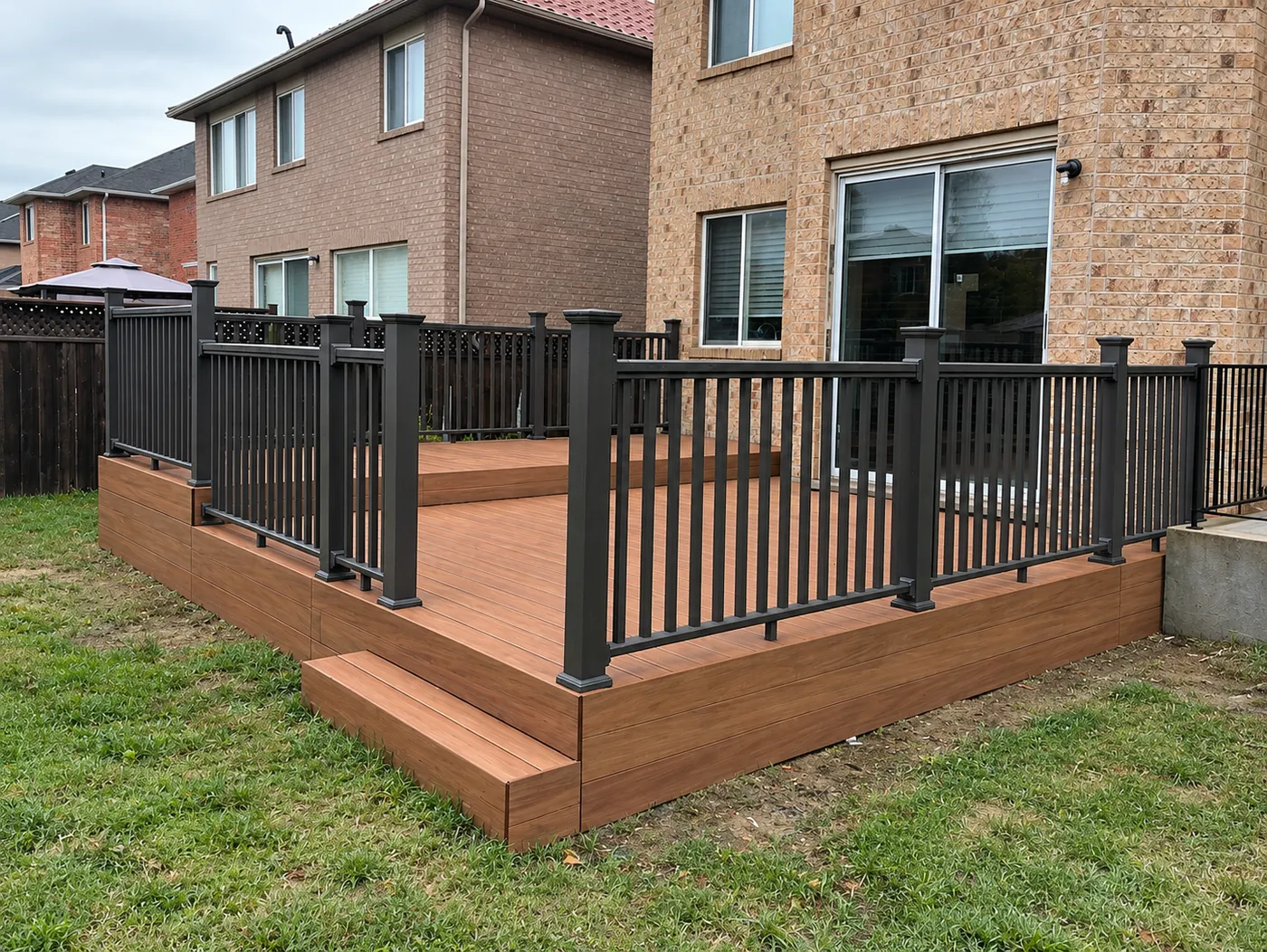
This is the reason to pay for glass. Pickets sit close enough that a 100 mm (4 in) ball can't pass between them, so from a chair you look through a row of bars. Standing up, you look over the top rail.
Glass in posts keeps the view open between the posts. Frameless glass has no posts at all, just panels held at the deck edge by stainless spigots or a low channel called a base shoe. On a deck over a ravine, a pool or a garden, that open view is what you're paying for. On a deck that faces a fence across a small yard, it isn't.
Cleaning and upkeep
Neither one needs stain or paint. Duradek, a Canadian railing maker, says to wash its aluminum and glass railings at least twice a year with mild soap, water and a soft sponge, use glass cleaner on the glass, and keep abrasive cleaners, harsh solvents and steel wool off them.
Twice a year is enough for aluminum. Black pickets hide dust and pollen well. Glass doesn't. Water spots, tree pollen, the dog's nose and kids' hands all show, worst with the sun behind them. If you want it clear, plan on a rinse with the hose and a squeegee through the season.
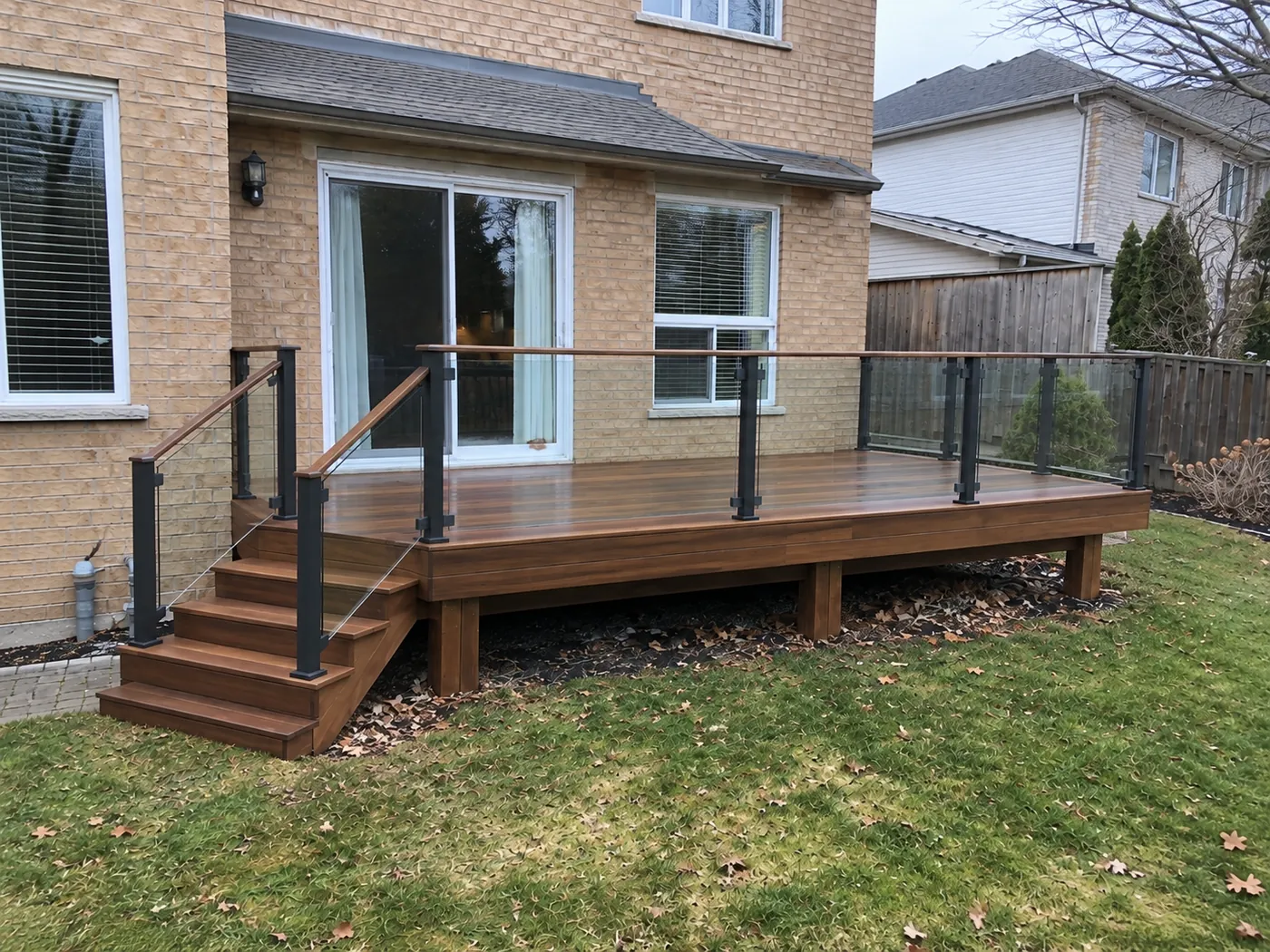
A wood top rail on a glass railing, like the ipe cap on this Burlington deck, needs the same oil or sealer as the deck boards.
Safety and inspection
Both pass inspection when they're built right, but neither one is a standard design in the Building Code the way a wood railing is. Markham's builder tip on guard loads, updated to the 2024 Code, says guards of glass or metal such as aluminum must be professionally engineered, with proof given to the inspector before they go in. We confirm the system's engineering before anything is ordered.
The same height and gap rules apply to both: 900 mm (36 in) on decks up to 1.8 m (5 ft 11 in) above grade, 1070 mm (42 in) above that, and no opening a 100 mm (4 in) sphere can pass. Our railing height guide has the rest.
For glass, the Code calls for safety glass of the laminated or tempered type, and tempered is allowed on a house deck. Tempered glass breaks into small pieces, and Guardian Glass notes they tend to fall out of the frame. A glass railing with posts and a top rail still has a rail across the opening if a panel breaks. Frameless glass has no rail, so the panel is the guard.
For aluminum, the catch is the style. Vertical pickets pass. Horizontal bar and cable designs can break the rule against footholds between 140 mm (5-1/2 in) and 900 mm (36 in) above the deck, so we check the system before you settle on one.
Either way, every post bolts to solid blocking in the deck frame. A railing is only as strong as what's under it.
Glass and birds
FLAP Canada, a Toronto-based bird safety group, calls glass railings bird-killers. Birds see the trees and plants through the glass and try to fly through. It matters most on decks that back onto a ravine, a treed lot or a garden.
FLAP's fix is markers on the outside face of the glass in a 50 mm (2 in) grid, or glass that's etched or patterned to the same spacing. It says falcon silhouette stickers don't work, because they leave too much clear glass.
How to choose
- Glass: the view is why you sit out there, the house is modern, or pickets would darken a walkout under the deck
- Aluminum: stairs, side runs, a tighter budget, or a deck you don't want to clean
- Both: the deck has one good side. Glass where you look out, aluminum on the sides and stairs, in the same post colour so it reads as one railing
Replacing the railing on an existing deck? Check the frame first. A new railing bolted to soft posts will move, whatever it's made of. Our repair or replace guide shows how to check it.
Our glass railing and aluminum railing pages have more photos and projects. Or send us photos of your deck, the rough length of railing and how high it sits off the ground, and we'll price both.
Sources: 2024 Ontario Building Code, Articles 9.8.8.1 to 9.8.8.7; City of Markham, Builder Tip 62, Loading on guards; Duradek, Railing care and cleaning; Guardian Glass, Safety glass; FLAP Canada, Mitigating glass railings. Checked October 2026.
Keep reading
Deck cost guide
Installed prices per sq ft by material, plus railings and stairs.
Learn moreFence cost guide
Installed prices per linear foot by fence type, plus gates.
Learn moreBest fence for privacy
Which styles block the view, what they cost and how tall they can go.
Learn moreFence post depth in Ontario
How deep posts go, concrete or gravel, and how frost lifts them.
Learn moreQuestions
Is glass or aluminum railing cheaper?
Do glass and aluminum railings need an engineer in Ontario?
Is a tempered glass railing safe on a deck?
Can you mix glass and aluminum railings on one deck?
Tell us about your deck or fence
Send a few photos and rough measurements. We'll come back with next steps and a time to see the site.