What's the Best Fence for Privacy in the GTA?
Board-on-board, horizontal, vinyl and composite compared for privacy and price, plus the height limits that decide how much any fence can block.
For most GTA backyards, the best privacy fence is a board-on-board wood fence built to the full height your city allows. The boards overlap on both sides of the rails, so when the wood dries and shrinks, no gaps open up. It also looks finished from both sides, which helps when the fence is shared.
If you never want to stain a fence, solid vinyl or composite panels block the view just as well. Horizontal boards work too, as long as the gaps are tight. Whichever you pick, height does more for privacy than the material, and every city caps it.
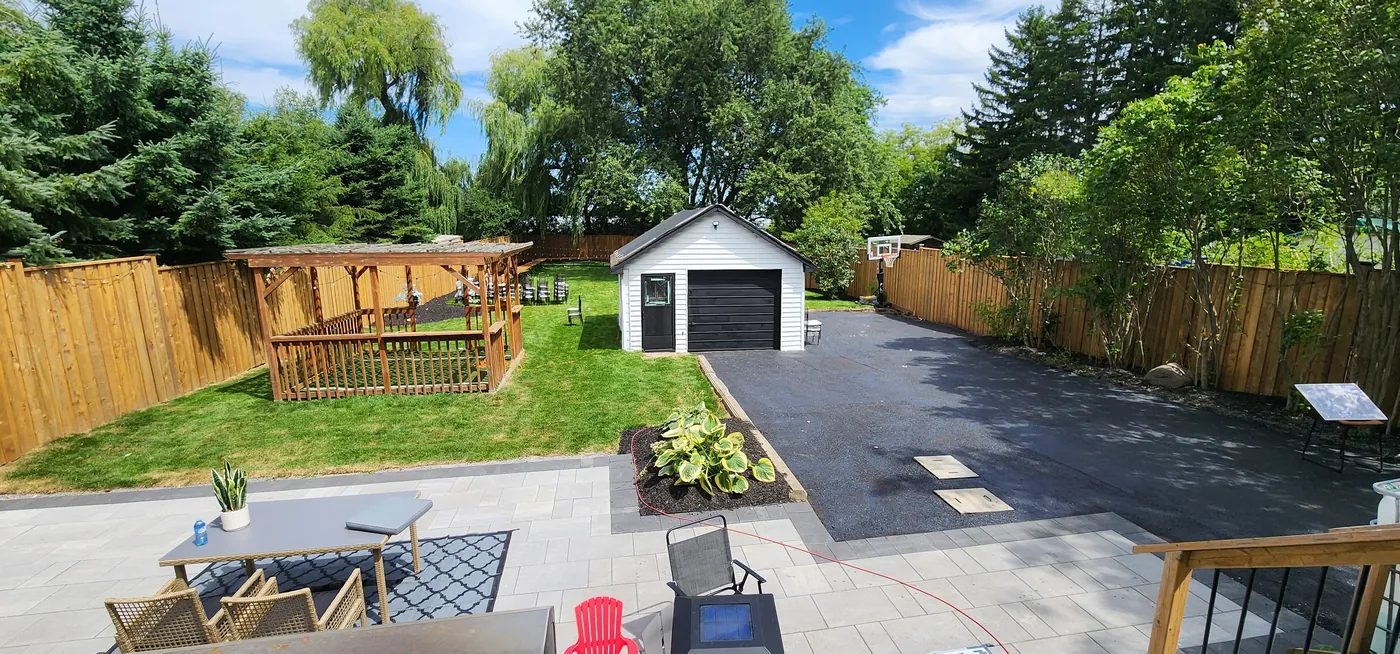
Height decides how much you block
A privacy fence can only be as tall as the bylaw allows. Most GTA cities cap backyard fences at about 2 m (6 ft 7 in), and a few go lower:
- Toronto: 2.0 m (6 ft 7 in) for most rear and side yard fences between house lots, measured from the average grade 1 m (3 ft 3 in) out on each side of the fence
- Mississauga and Brampton: 2 m (about 6 ft 7 in) in rear and side yards
- Markham and Richmond Hill: 1.8 m (5 ft 11 in) in rear and side yards
Lattice doesn't get you around the limit. Markham allows 0.3 m (1 ft) of lattice on top of a rear fence only if the total stays within the maximum, and Aurora and Clarington count lattice in the height. Check your city in our fence height guide.
Going taller means applying for an exemption, with a fee and no promise of approval. Our Toronto fence permit guide explains how that works in Toronto.
Privacy fence styles compared
Prices are from our fence cost guide, installed and before HST.
| Style | Privacy | Installed, per linear ft |
|---|---|---|
| Board-on-board wood | Full, stays closed as boards shrink | $70 to $100 treated, $90 to $120 cedar, upper end |
| Solid board wood | Full, thin gaps can open as boards dry | $70 to $100 treated, $90 to $120 cedar |
| Horizontal board | Full with tight gaps, partial with wide ones | $100 to $140 |
| Vinyl privacy panels | Full | $55 to $120 |
| Composite | Full | $90 to $160 |
| Aluminum pickets | Open, unless slats or panels are added | $80 to $200 |
Gates and removal of the old fence are extra. The number for your yard comes after a site visit or a look at photos and your survey.
Why board-on-board stays private
Wood shrinks across its width as it dries. An Oklahoma State University Extension fact sheet puts shrinkage across the grain at about 4% to 11% for the species it lists, from green wood to fully dry. On a fence with boards butted tight in a single row, that shows up as thin gaps. Up close, you can see through them.
Board-on-board puts boards on both sides of the rails, each one covering a gap on the other side. When they shrink, there's still a board behind every gap. It uses more boards than a single row, which is why it sits toward the top of the wood price ranges.
It has no bad side either. Your neighbour sees the same finished fence you do. Our cedar vs pressure-treated guide helps you pick the wood.
Horizontal boards: private if the gaps are tight
A horizontal fence gives full privacy when the boards sit close together. Wider gaps look lighter and let the air through, but you can see through them. Long boards need closer posts and a centre support to stay straight, which is why horizontal costs more per foot.
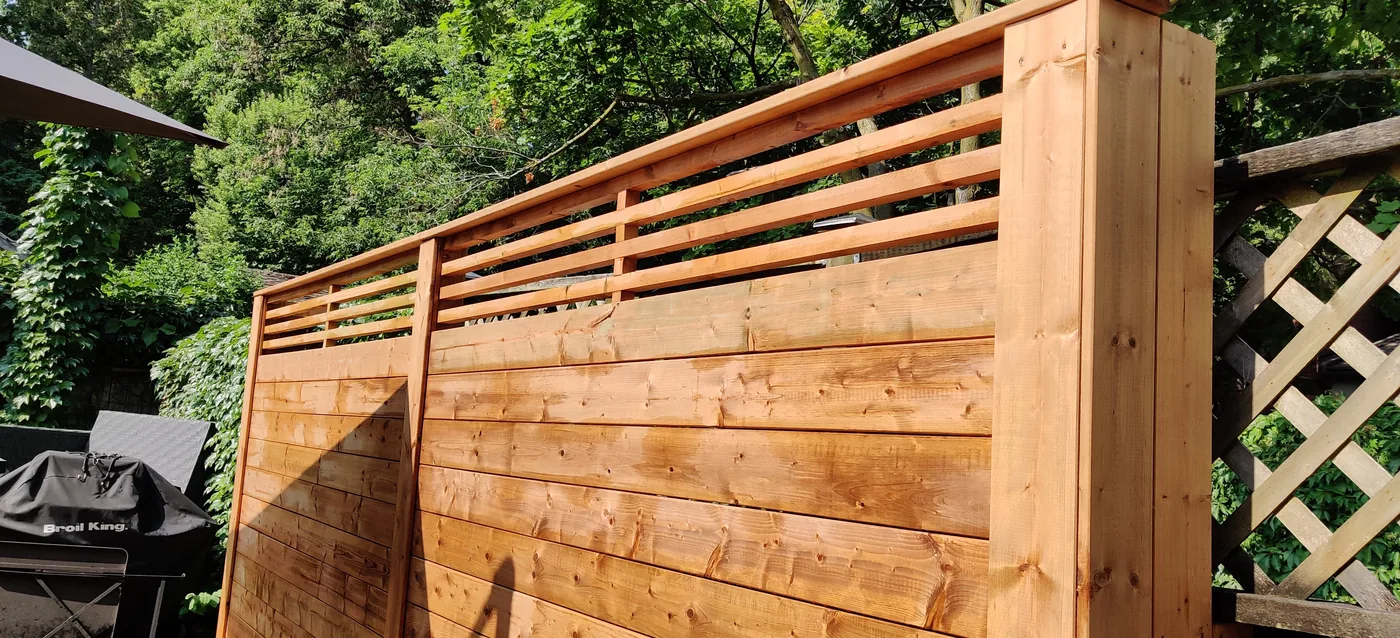
A good middle ground is solid boards up to eye level with an open slat section on top. On this King City job, horizontal boards on posts tied into the deck block the view where people sit, and the spaced slats above let the light and the tree line through.
Vinyl and composite: privacy without stain
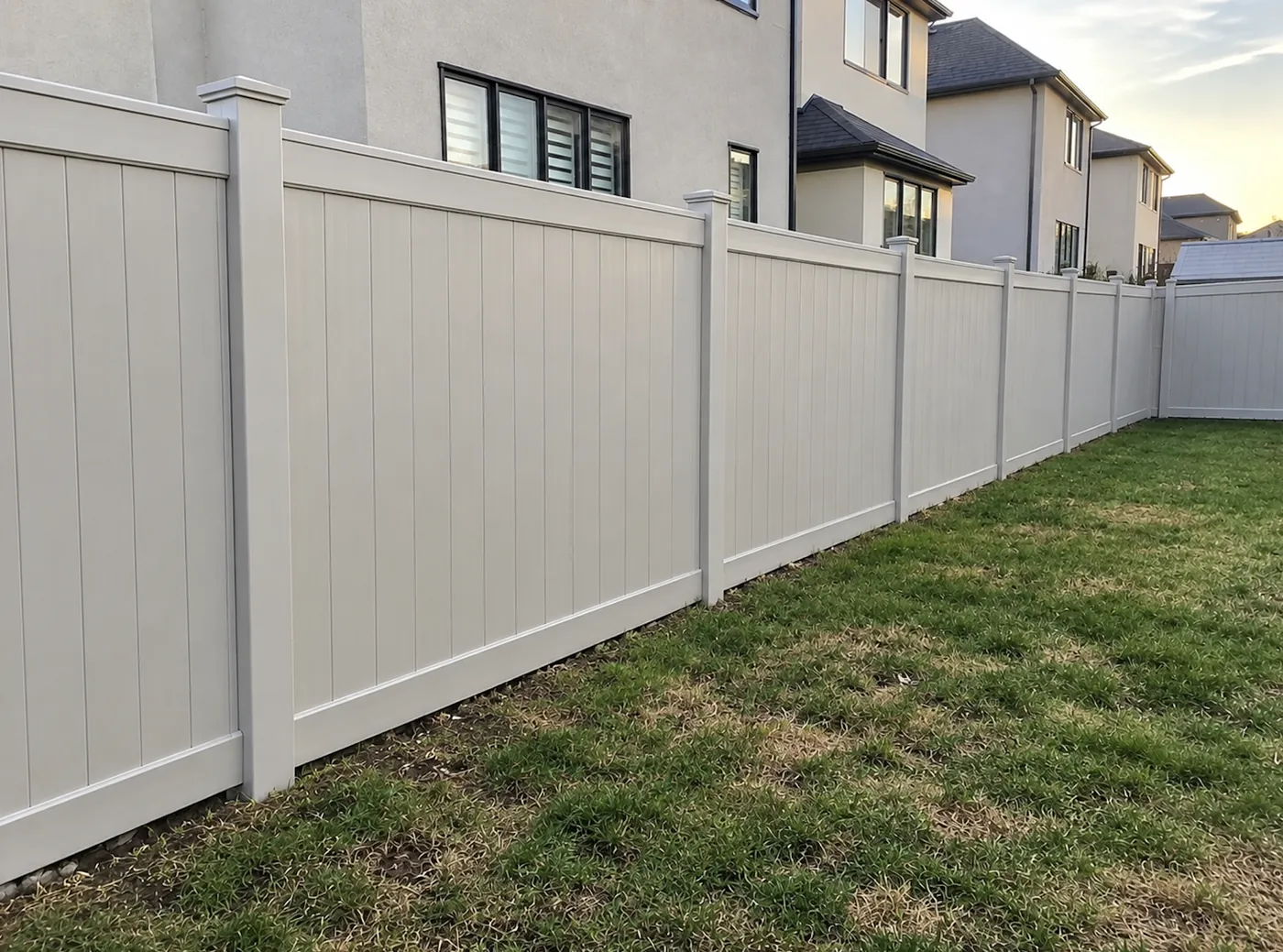
Solid vinyl panels and composite boards block the view completely, and neither one ever needs stain. Vinyl has a smooth, even colour that stays the colour you picked. Composite has a wood-grain look. Both usually cost more than a basic pressure-treated fence up front, and you make some of that back by never staining.
Watch the posts. Vinyl posts are hollow, so the footing carries the fence. Set too shallow, the line walks after the first winter while the panels still look perfect.
Lattice tops: light, not extra height
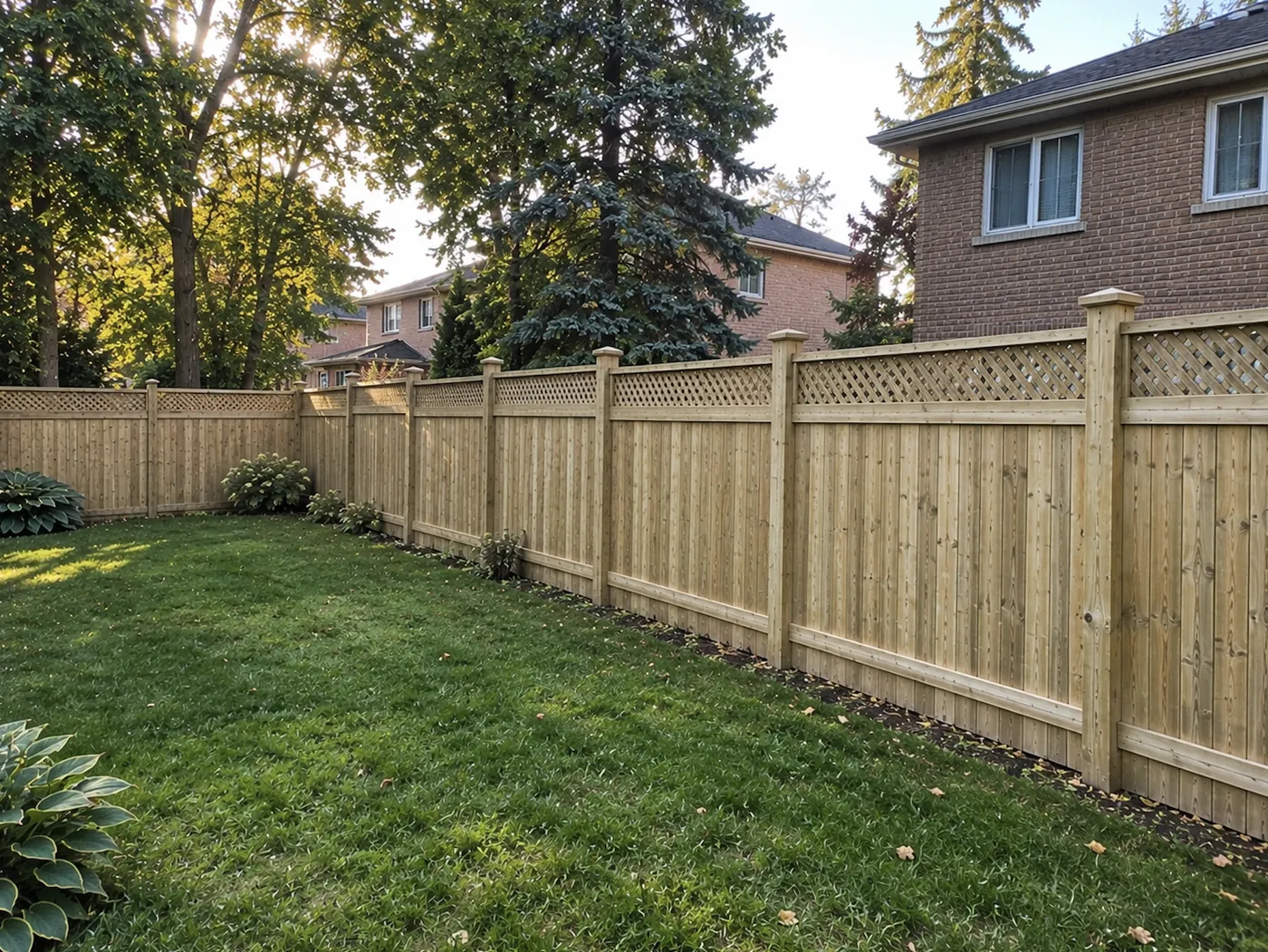
A lattice or open top softens a tall fence and lets light into the yard. In most cities it doesn't buy height over the bylaw, so plan the solid section and the lattice together to fit under the limit.
When a fence can't block the view
A 2 m fence on the lot line won't hide you from a neighbour's raised deck or a second-storey window. For that, put the privacy where you sit. A privacy screen on the deck or beside the patio blocks the sightline closer to your eye, so it does more with less height.
Screens have their own rules. In Toronto, a fence on an unroofed deck can be 2.0 m (6 ft 7 in) above the deck boards, as long as it isn't in the front yard or within 2.4 m (just under 8 ft) of a lot line along a street. Other cities set different limits, and we check them for your address.
A solid fence needs solid posts
A privacy fence is a wall to the wind, and its posts take that load every storm. We set fence posts in concrete about 1.2 m (4 ft) deep, below the frost line, with the top of the concrete sloped to shed water. Tall fences, lattice tops and gates get 6x6 posts. Our fence post guide explains why.
New posts mean digging, so locates come first through Ontario Dig Authority (formerly Ontario One Call).
Sharing it with a neighbour
A privacy fence on the lot line is usually shared, and many neighbours split the cost. Confirm where the line is before anything goes in the ground. A survey is the safest way. Our fence line and neighbour guide covers Ontario's Line Fences Act.
To price it, send us the length, the height you have in mind, the style you like and a few photos. We'll confirm your city's limit and price the options side by side.
Sources: City of Toronto, Municipal Code Chapter 447, Fences; City of Mississauga, Fences; City of Brampton, Fences; City of Markham, Fences and swimming pools; City of Richmond Hill, Fence by-law; Oklahoma State University Extension, Dimensional changes in wood; Ontario Dig Authority, Locates overview. Checked October 2026.
Keep reading
Deck cost guide
Installed prices per sq ft by material, plus railings and stairs.
Learn moreFence cost guide
Installed prices per linear foot by fence type, plus gates.
Learn moreGlass vs aluminum railings
Cost, view, cleaning and inspection compared, and when to mix them.
Learn moreFence post depth in Ontario
How deep posts go, concrete or gravel, and how frost lifts them.
Learn moreQuestions
What is the most private type of fence?
How tall can a privacy fence be in the GTA?
Is board-on-board worth the extra cost?
Is a horizontal fence as private as a vertical one?
Tell us about your deck or fence
Send a few photos and rough measurements. We'll come back with next steps and a time to see the site.