Good Neighbour Fence: Which Side Faces Out, and Who Decides
There's no Ontario rule on which side of a fence faces out. Here's who decides, what happens when neighbours disagree, and the styles that look finished from both yards.
No Ontario law says which side of a fence has to face your neighbour. We checked the province's Line Fences Act guide, Toronto's fence bylaw, Whitby's fence bylaw and the cost sharing bylaws in Ajax and Whitby. None of them sets a rule for an ordinary backyard fence. The custom is to put the finished face toward the neighbour or the street, with the posts and rails on your side.
Who decides depends on where the fence sits. If it's fully on your property, you do. If it's on the property line, it's shared, and the two of you decide together. The easy way around the question is a good neighbour fence: a style that looks finished from both yards.
What a good neighbour fence is
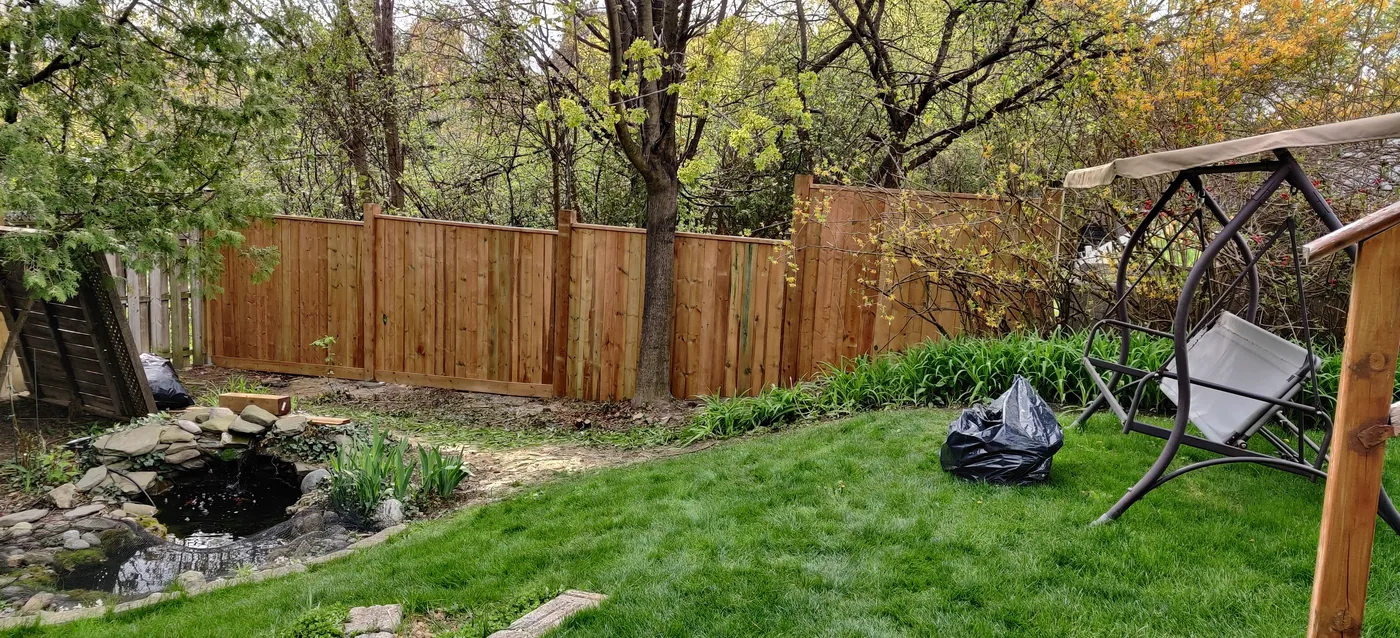
A good neighbour fence has no back side. Neither yard looks at bare posts and rails. The common ways to get there:
- Board-on-board wood: boards on both faces of the rails, overlapping, so each yard sees boards. Our best privacy fence guide explains why it also stays closed as the wood dries
- Vinyl privacy panels: the panels sit in the posts and usually look the same from both sides
- Composite: many systems slot the boards into the posts, so both faces match. Check the system you pick
- Aluminum pickets: open, and the same from both sides
Fence styles by which side looks finished
Prices are from our fence cost guide, installed and before HST.
| Style | What each yard sees | Installed, per linear ft |
|---|---|---|
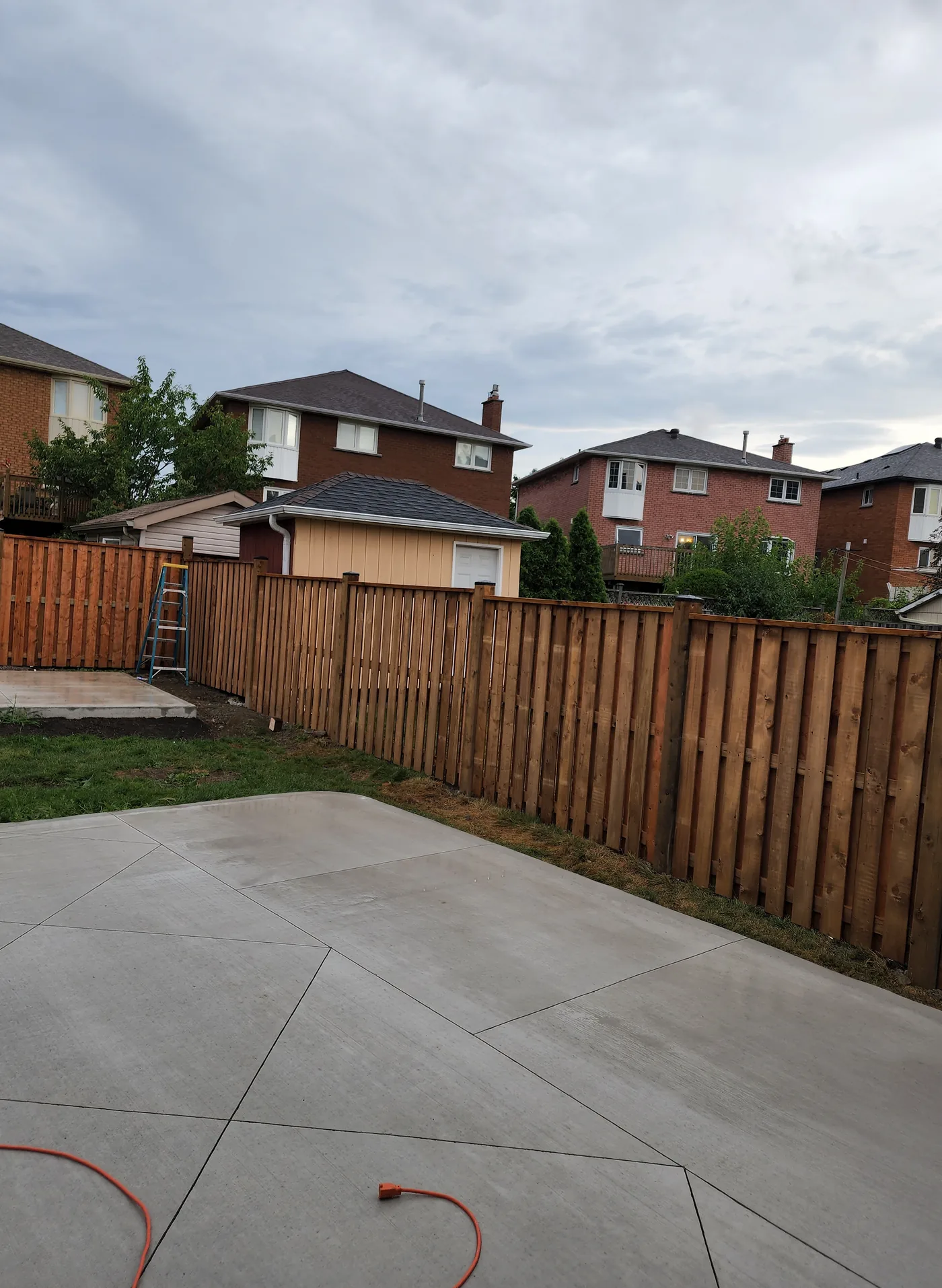
| Single row of boards | Boards on one side, posts and rails on the other | $70 to $100 treated, $90 to $120 cedar |
| Board-on-board | Boards on both sides | Upper end of the wood ranges |
| Horizontal boards | Usually boards on one face, posts on the other | $100 to $140 |
| Vinyl privacy panels | Usually the same on both sides | $55 to $120 |
| Composite | Usually the same on both sides, check the system | $90 to $160 |
| Aluminum pickets | The same on both sides | $80 to $200 |
Gates and removal of the old fence are extra. The number for your yard comes after a site visit or a look at photos and your survey.
Which side faces out
With a single row of boards, one yard gets the clean face and the other gets the frame. Most owners give the neighbour the finished face as a courtesy, and most neighbours expect it. No bylaw we found requires it.
There's a practical side too. With the rails on your side, you can stain the frame, tighten a loose board or swap a rail without leaving your yard. If the rails face the neighbour, fixing them means working from their yard.
When a rule does decide it
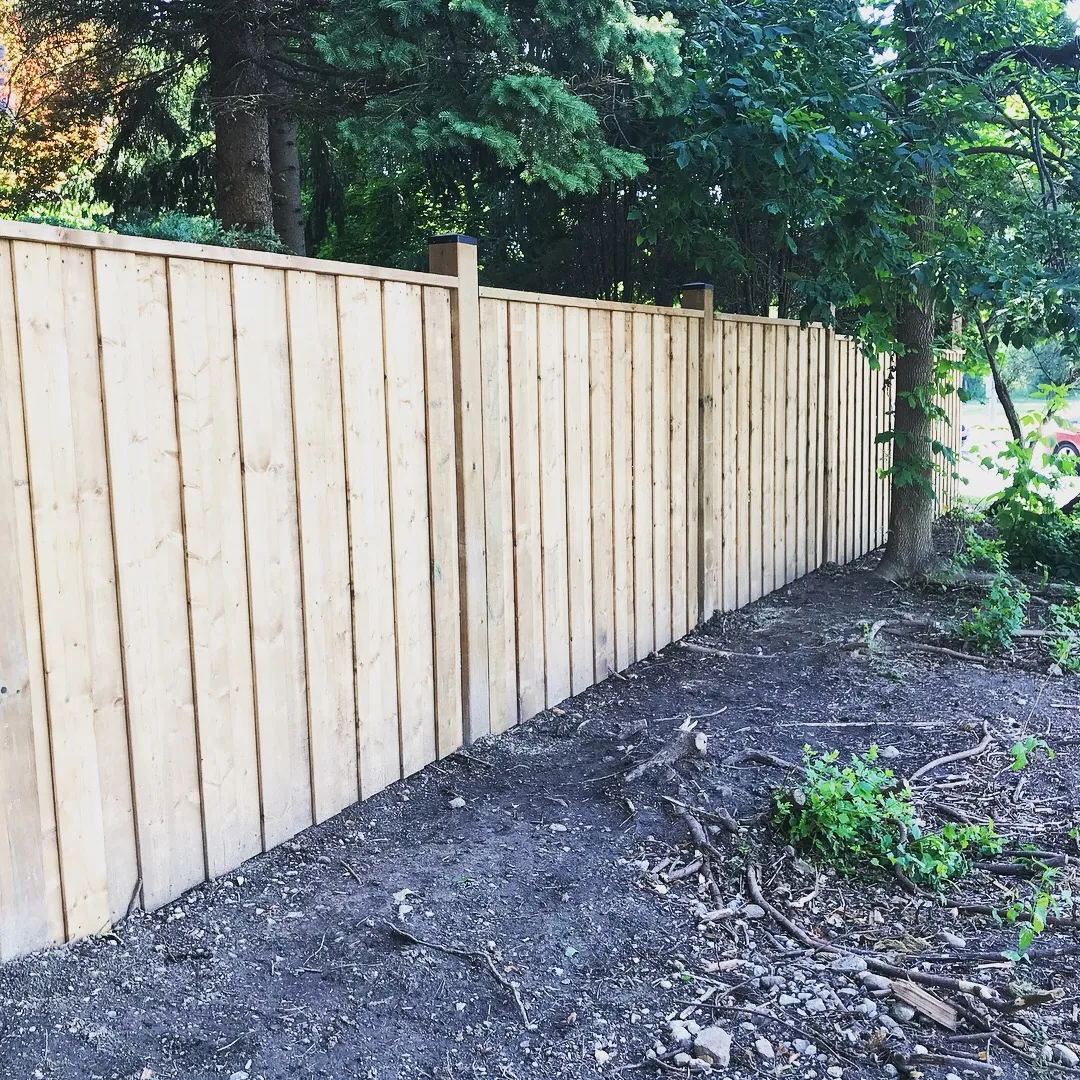
Pool enclosures. A pool fence has to be hard to climb from the outside. Pool bylaws, Toronto's included, don't allow rails, braces or anything else climbable on the outside between 100 mm (4 in) and 1.2 m (3 ft 11 in) above the ground. On a wood or vinyl pool fence, that puts the rails on the pool side and the boards facing out. See our pool fence page and pool fence rules by city.
Privacy screens in Whitby. Whitby's Fence By-law 8228-25 doesn't allow a privacy screen with "an inferior appearance or quality on the side of the privacy screening which faces the adjoining property." It's the only side rule we found in a GTA bylaw, and it covers privacy screens, not fences.
Who decides
Fully on your property. If the whole fence, posts included, sits on your side of the line, it's your fence. You choose the style, the height within the bylaw and which way it faces. You also pay for it and look after it. Setting it a little inside the line avoids any question about whose it is.
On the line. A fence on the property line is shared. Agree on the style, the height, which side gets the finished face, how the cost splits and who does the upkeep, and put it in writing before anyone books a crew. We can quote the shared fence so you both see the same numbers.
Either way, confirm where the line is first. An old fence isn't proof. A survey is.
If you can't agree
Cost sharing bylaws. Some towns have their own. In Ajax and Whitby, if there's no written agreement, the neighbour pays half the basic cost of a new division fence or half the actual cost, whichever is less. The basic cost is set at a plain 1.2 m (4 ft) galvanized chain link fence. So if you want a 2 m (6 ft 7 in) board-on-board cedar fence and your neighbour doesn't, their share stops at half the price of chain link and you cover the rest. Both bylaws need notice by registered mail at least 14 days before the work starts.
The Line Fences Act. Outside Toronto, the Act applies unless your municipality has opted out. One owner asks the municipality for fence-viewers. They can decide how the work is split between the owners and describe the fence to be built, including the materials. An owner who disagrees with the award has 15 days from receiving it to appeal. The process only works before the fence goes in. Build first and send your neighbour the bill, and the Act won't help.
Toronto. Toronto opted out of the Line Fences Act in 2018, apart from one section, and no longer takes applications for fence viewing. The City says boundary fence disputes are for the neighbours to settle, and points to free mediation through TNG Community Services or the civil courts. Our fence line and neighbour guide covers both.
This is general information, not legal advice. For a real dispute, talk to your municipality or a lawyer.
Before the posts go in
Whichever way it faces, the fence is built the same. We set posts in concrete about 1.2 m (4 ft) deep, below the frost line. Our fence post guide explains why. New posts mean digging, so locates come first through Ontario Dig Authority (formerly Ontario One Call). Check your city's height limit in our fence height guide.
To price a shared fence, send us the length, the style you've agreed on and a few photos.
Sources: Government of Ontario, Line Fences Act; City of Toronto, Line fences and fence disputes and Municipal Code Chapter 447, Fences; Town of Whitby, Fence By-law 8228-25 and Division Fence By-law 3657-95; Town of Ajax, Fence Cost Sharing By-law 37-2017; Ontario Dig Authority, Locates overview. Checked November 2026. This guide is general information, not legal advice.
Keep reading
Deck cost guide
Installed prices per sq ft by material, plus railings and stairs.
Learn moreFence cost guide
Installed prices per linear foot by fence type, plus gates.
Learn moreTrex vs Fiberon vs TruNorth
Board lines, caps and warranties compared, and what matters more.
Learn moreHorizontal vs vertical fence
Cost, gaps and what keeps long boards straight.
Learn moreQuestions
Which side of a fence faces the neighbour in Ontario?
What is a good neighbour fence?
Can my neighbour make me put the good side toward them?
Does my neighbour have to pay for a fancier fence?
Tell us about your deck or fence
Send a few photos and rough measurements. We'll come back with next steps and a time to see the site.