Horizontal Fences: Cost, Design and What Holds Up
What a horizontal fence costs against a vertical one, how to choose the gaps, and what keeps long boards straight through Ontario winters.
A horizontal fence costs more than a vertical board fence. Expect about $100 to $140 per linear foot installed, before HST, against $70 to $100 for pressure-treated and $90 to $120 for cedar. The extra pays for closer posts, a support in the middle of each section and slower, more careful building.
Built that way, it stays as straight as any other fence. When the posts are too far apart, long boards sag and the gaps wander. Below is what changes when the boards run sideways, and how we keep them straight through an Ontario winter.
Horizontal vs vertical at a glance
Prices are from our fence cost guide, installed and before HST.
| Horizontal board | Vertical board | |
|---|---|---|
| Per linear ft | $100 to $140 | $70 to $100 treated, $90 to $120 cedar |
| 100 ft of fence | $10,000 to $14,000 | $7,000 to $10,000 treated, $9,000 to $12,000 cedar |
| Look | Modern, long level lines | Traditional, suits most homes |
| Privacy | Full with tight gaps | Full with board-on-board |
| Posts | Closer together, plus a centre support | Usually up to 2.4 m (8 ft) apart |
| On a slope | Steps down section by section | Can step or follow the grade |
| Around a pool | Gaps can act as footholds | Rails go on the pool side |
Gates and removing the old fence are extra. The number for your yard comes after a site visit or a look at photos.
Why horizontal costs more
On a vertical fence, the boards hang on rails and the rails carry them from post to post. On a horizontal fence, each board does the job of a rail. It spans the section on its own, so the spans have to be shorter. That means more posts, more holes and more concrete for the same length of fence.
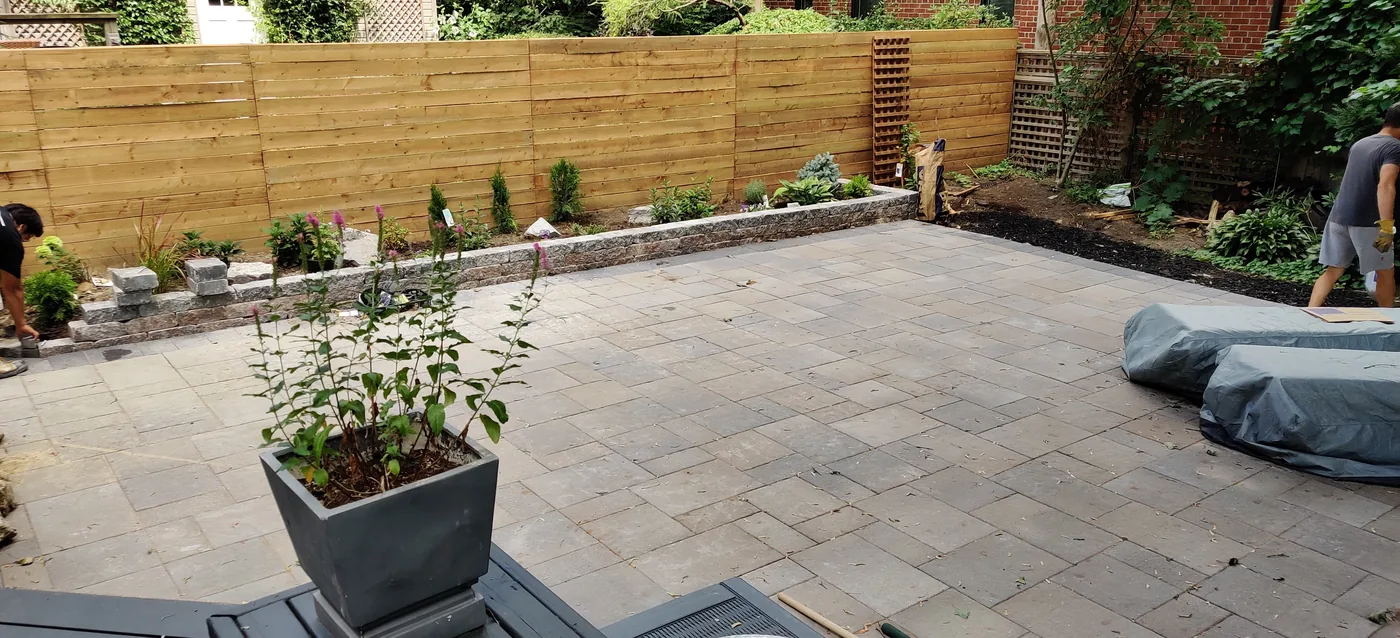
Most horizontal fences also get a centre support in each section and a top cap. Every board end lands on a post, so the posts have to be plumb and evenly spaced. If they aren't, the lines show it across the whole run. Our East York fence and patio job is about 140 ft of 6 ft horizontal boards in pressure-treated wood. Many horizontal fences are also built in cedar, which raises the material cost.
Gaps and design choices
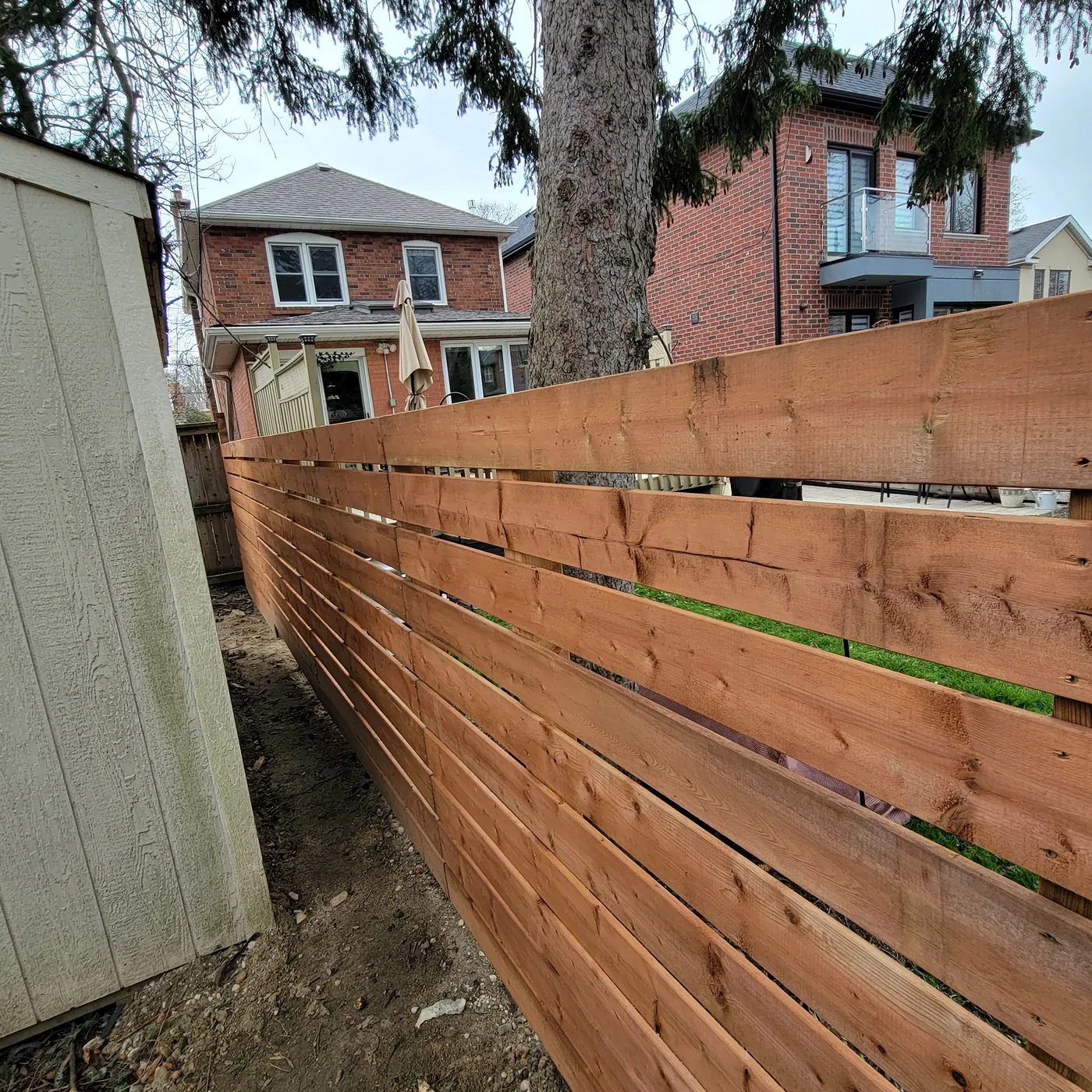
The gap between boards is the biggest design decision. Tight gaps give full privacy. Wider gaps look lighter and let air and light through, but you can see through them, more so at an angle.
Wood moves, and on a horizontal fence it moves in a useful direction. An Oklahoma State University Extension fact sheet lists western redcedar shrinking about 5% across its width from green to oven-dry, and calls shrinkage along the length negligible for practical purposes. So the boards keep their length from post to post, but each one narrows a little as it dries and the gaps open slightly. We set the gaps with spacers so they stay even from one end of the fence to the other, and we size them knowing the boards will shrink.
Other choices to make before we price it:
- Board width. Wider boards mean fewer lines, narrower boards look finer
- A solid lower section with an open slat top to let the light in
- A matching horizontal gate, hung on its own post
- Steel posts with wood boards, for a modern look and a long post life
- Stain colour, or cedar left to weather to grey
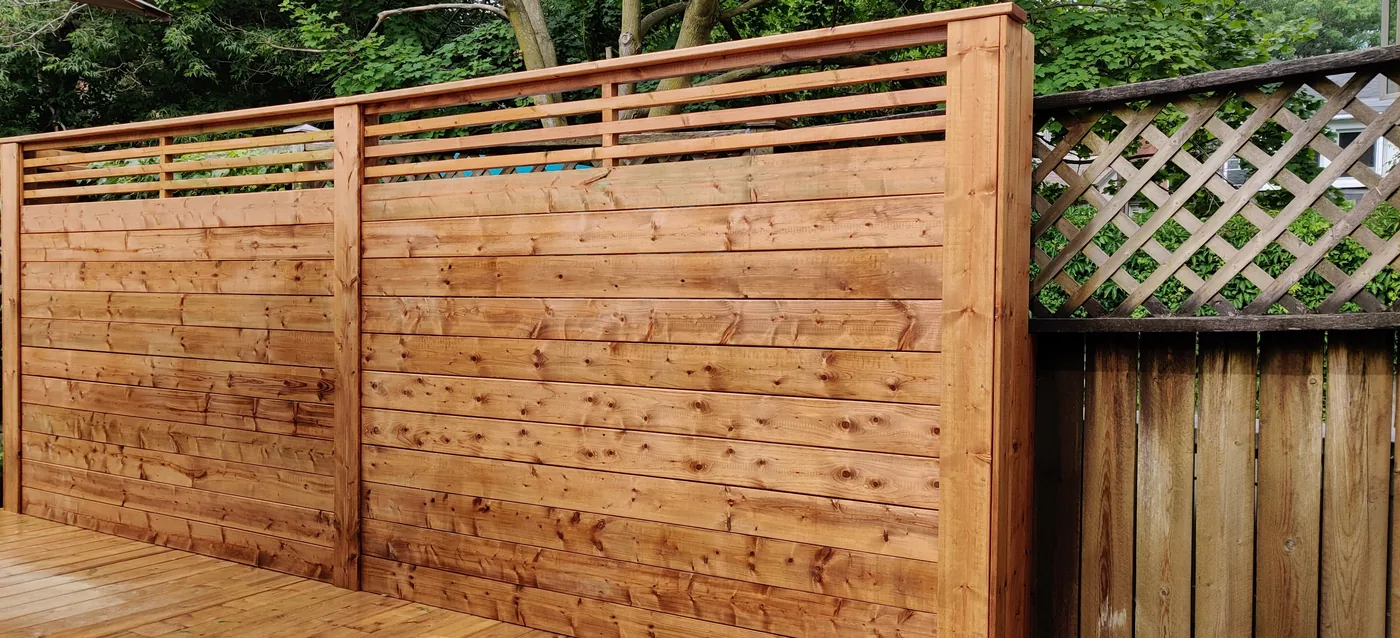
On this King City job, horizontal boards run to eye level with spaced slats above, and the new run ties into the old lattice panel fence.
What holds up
A horizontal fence lasts when the posts stay put and every board is held at every support. This is how we build one:
- Posts set in concrete about 1.2 m (4 ft) deep, below the frost line, with the top sloped to shed water. Tall fences and gates get 6x6 posts. Our fence post guide explains why
- Posts closer together than the 2.4 m (8 ft) we use on a vertical board fence, so long boards don't sag
- A centre support in each section, fastened to every board
- Corrosion-resistant fasteners at every post and support. The Canadian Wood Council says nails in copper-treated wood must be hot-dip galvanized and points to stainless steel for the longest life. Real Cedar lists hot-dip galvanized, aluminum and stainless for cedar and recommends stainless screws
- Screws long enough to reach at least 25 mm (1 in) into the post or support, the minimum Real Cedar gives
- A top cap over the board ends, and cut ends on treated boards brushed with preservative, as Wood Preservation Canada recommends
- The bottom board kept off the soil and out of the mulch
- Locates through Ontario Dig Authority (formerly Ontario One Call) before any post hole is dug
Cedar or pressure-treated? Both work. Cedar sits flatter and straighter as it dries, which matters most on long horizontal runs. Pressure-treated costs less and makes a sound fence on well-set posts, like the East York job. Our cedar vs pressure-treated guide compares them.
Height, pools and decks
A horizontal fence has the same height limits as any other fence. In Toronto, most rear and side yard fences between house lots can be 2.0 m (6 ft 7 in). Check your city in our fence height guide, and see our privacy fence guide for how it compares with board-on-board, vinyl and composite.
Pools are where horizontal boards need care. Pool bylaws ban footholds on the outside of the enclosure and limit how big openings can be, and the gaps between horizontal boards can work like a ladder. If the fence will enclose a pool, we check your city's bylaw before you settle on the gaps. Our pool fence rules guide covers each city.
The same goes for a horizontal privacy wall on a raised deck. Where it also serves as the deck's guard, the Ontario Building Code says nothing between 140 mm (5-1/2 in) and 900 mm (36 in) above the deck may help a child climb it. Our deck railing guide explains the rule.
Slopes and repairs
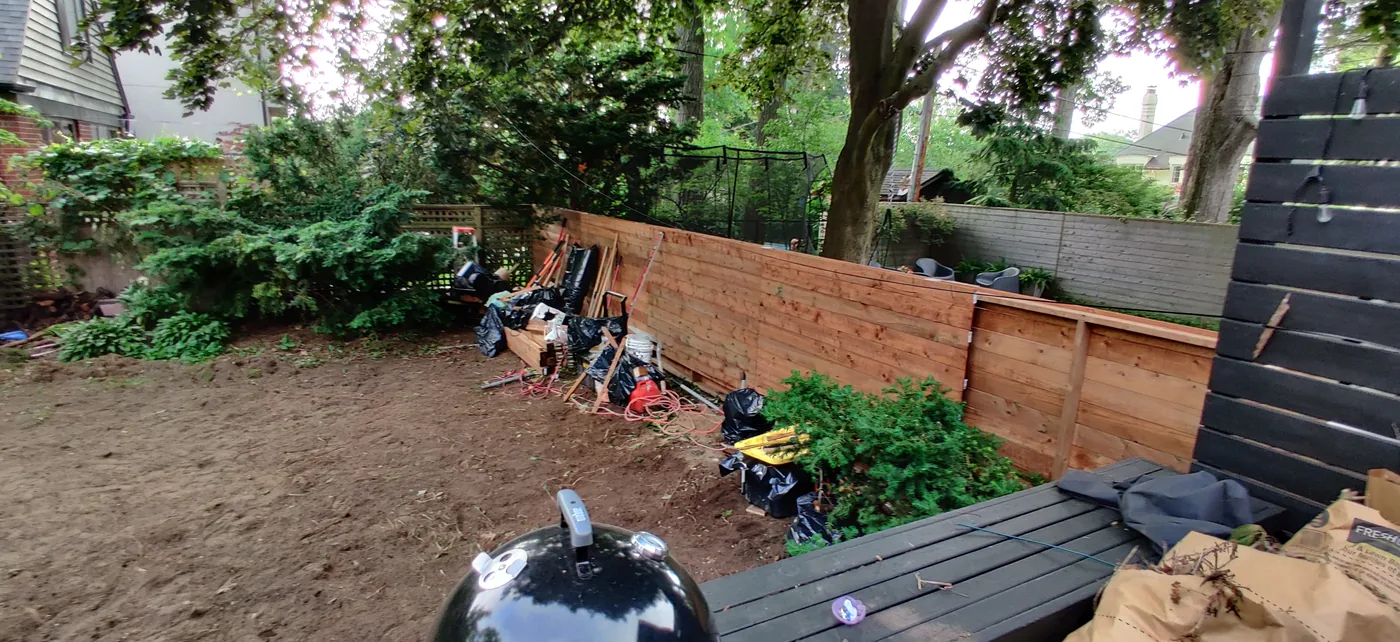
Horizontal boards look right only when they're level, so on a slope the fence steps down one section at a time. A vertical board fence can step or follow the grade. Uneven ground adds to the price of any fence.
Repairs are simple. A cracked board comes off and a new one goes in, post to post. The new board will stand out against weathered ones until it ages or gets stained.
To price one, send us the length, the height you want, the gap you like and a few photos of the yard. We'll check your city's limit and price it. See our horizontal fence page for more of our work.
Sources: Oklahoma State University Extension, Dimensional changes in wood; Canadian Wood Council, Fasteners; Real Cedar, Fasteners for outdoor projects; Wood Preservation Canada, The importance of field treating pressure treated wood products; City of Toronto, Municipal Code Chapter 447, Fences; Ontario, 2024 Ontario Building Code; Ontario Dig Authority, Locates overview. Checked November 2026.
Keep reading
Deck cost guide
Installed prices per sq ft by material, plus railings and stairs.
Learn moreFence cost guide
Installed prices per linear foot by fence type, plus gates.
Learn moreDeck permits by city
When a deck needs a permit in 24 GTA municipalities.
Learn moreBest fence for privacy
Which styles block the view, what they cost and how tall they can go.
Learn moreQuestions
Is a horizontal fence more expensive than a vertical one?
Do horizontal fences sag?
Is a horizontal fence private?
Can a horizontal fence go around a pool?
Tell us about your deck or fence
Send a few photos and rough measurements. We'll come back with next steps and a time to see the site.