Leaning Fence? Fix the Posts or Replace the Fence
Why fences lean, how to check the posts yourself, and when new posts will do the job instead of a whole new fence.
Most leaning fences have a post problem, not a fence problem. If a few posts have gone and the boards and rails are still solid, new posts will straighten it. Post replacement runs about $250 to $500 per post, installed, before HST.
If most of the posts are soft at the ground, or the boards are splitting and loose along the whole run, a new fence costs less over time than chasing repairs.
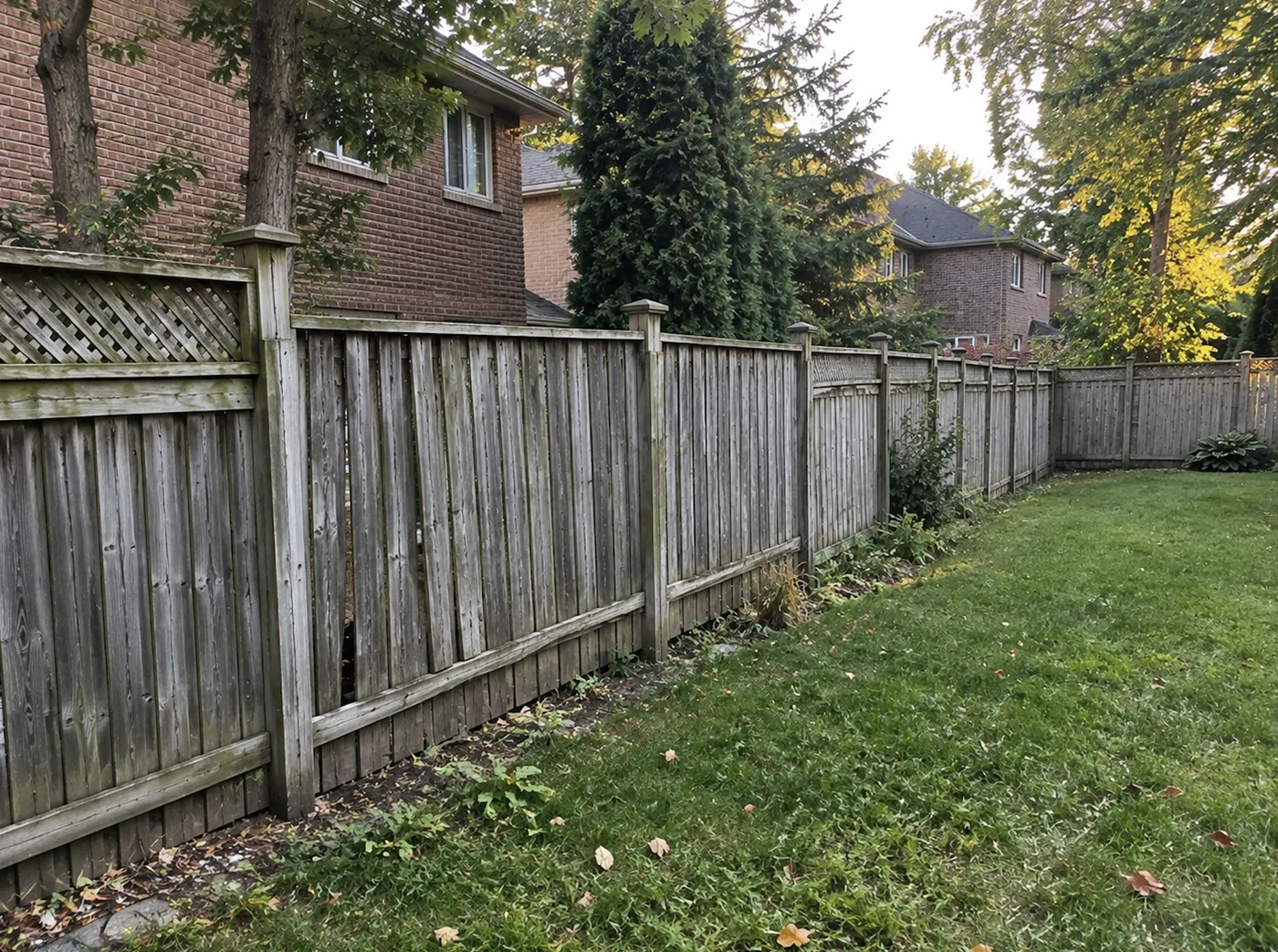
Why fences lean
A fence leans when a post moves or breaks. The boards and rails just go along with it. These are the usual causes:
- Rot at the ground line: the post rots just under the soil while the wood above it looks fine
- Frost heave: posts set too shallow, or in concrete that flares wide at the top, get lifted a little every winter
- Wind: a solid board fence catches wind like a sail, and a lattice top puts more load at the top of the post
- A gate: a walk gate hangs all its weight off one post, and that post often works loose first
Rot is the big one. Wood Preservation Canada notes that decay moves fastest just below ground level. Temperature swings are smaller there, and the moisture and oxygen suit the fungi that break wood down. That's why a post can look sound from the yard and snap at the soil line.
Frost heave usually shows up after a winter or two. Our fall and winter fence guide has a diagram of how frost lifts a shallow post.
How to check your fence yourself
You can learn a lot before anyone gives you a price. Walk the whole fence line and check each post:
- Push the top of the post. If it rocks at the ground, it has rotted through or broken loose from its footing
- Pull back the mulch or soil at the base by hand and press a screwdriver into the wood. If the tip sinks in easily, that's rot
- Look at the concrete. A footing that has risen above the grass, or tilted with the post, was moved by frost
- Check where the rails meet the posts. Sometimes the post is fine and a rail has split or the nails have pulled out
- Look along the boards. Grey, split and loose along the whole run means the fence itself is near the end
- Count the posts that move, and take photos of the worst ones and of the whole fence
Fix the posts or replace the fence?
It comes down to how many posts have failed and what shape the rest of the fence is in. This is how we decide on site:
| What you find | What usually makes sense |
|---|---|
| A few posts loose, boards and rails solid | Replace those posts and fasten the fence back on |
| Posts solid, a rail split or nails pulled out | Repair the rail and refasten. No new posts needed |
| A sound post lifted by frost | Dig it out and reset it deeper, or replace it |
| Most posts soft at the ground | Replace the fence. It usually costs less over time than replacing posts one by one |
| Boards grey, split and loose along most of the run | Replace the fence, even if some posts are still good |
| A shared fence on the property line | Agree on the work and the cost with your neighbour first |
What the numbers look like
Say three posts have gone on a 100 ft pressure-treated fence and the boards are still good. At $250 to $500 a post, that's about $750 to $1,500.
A new 100 ft pressure-treated fence runs $7,000 to $10,000. Taking the old one away adds $5 to $15 per linear ft, about $500 to $1,500 more. When most of the posts are going, you end up paying for a string of repairs while the old boards and rails keep wearing out. Prices are installed, before HST, from our fence cost guide.
What a post replacement involves
Pushing the fence back up and pouring concrete around the old post doesn't fix it. The rot is still there, under the new concrete. A proper post replacement goes like this:
- Utility locates before any digging. Ontario Dig Authority (formerly Ontario One Call) marks utility lines for free, with 5 business days' notice for a single address. Private lines, like a gas line to a BBQ or power to a shed, need a private locator
- The fence sections on either side are braced or taken off
- The old post and its concrete are broken out and hauled away. A new post set into an old hole full of old concrete is how a repair starts moving again
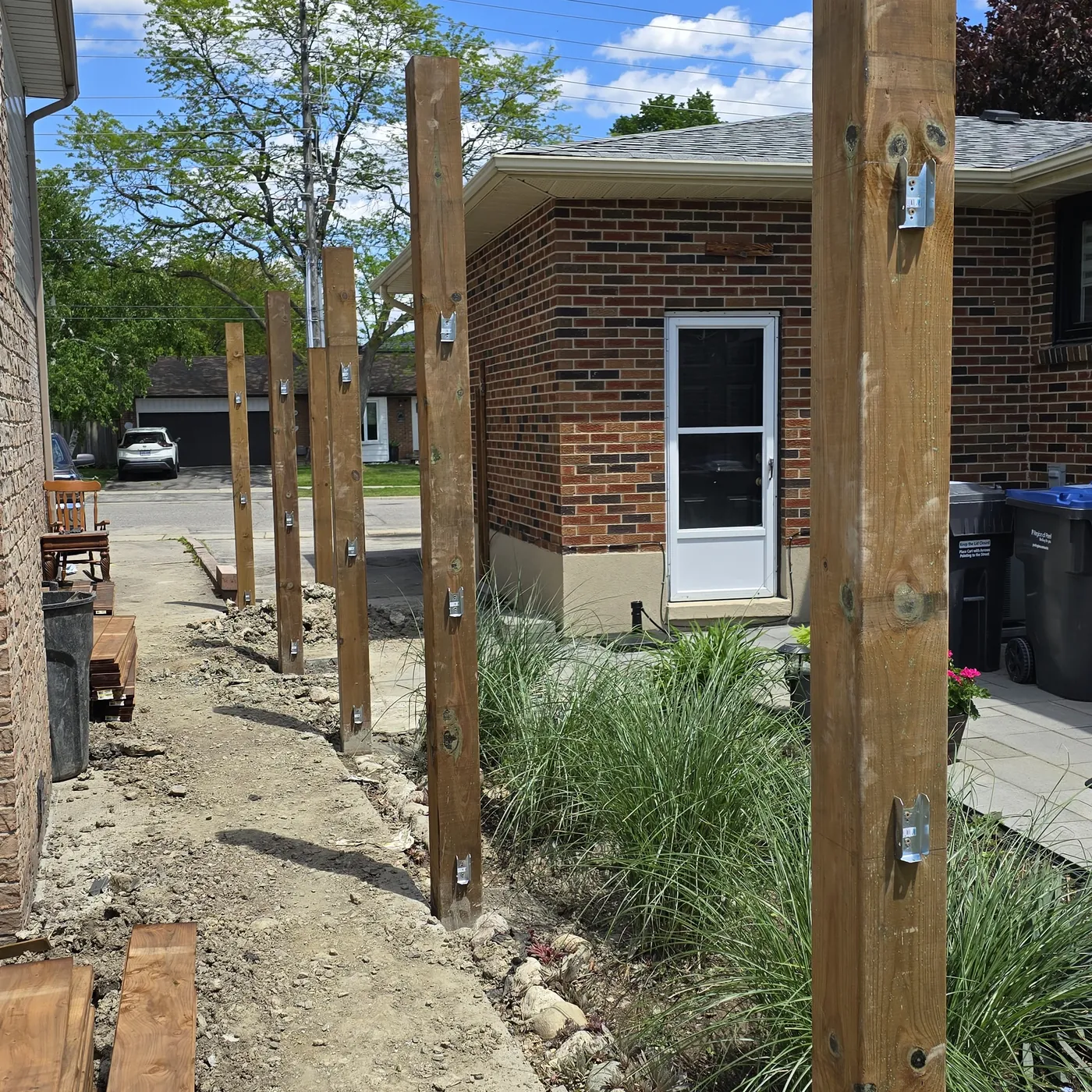
- A new post rated for ground contact goes into fresh concrete about 1.2 m (4 ft) deep, below the frost line
- The top of the concrete is sloped so water runs off instead of sitting against the wood
- Rails and boards are fastened back on, plumb and in line with the rest of the fence
Where a fence runs across a concrete path or patio, the new post can sit on a steel base bolted to the slab instead. We did that on a fence post replacement in Markham, where 15 posts were replaced and the owner kept the panels.
Until the work is done
If a section is leaning hard after a storm, brace it with a 2x4 running from the fence down to a stake in the ground, and keep kids and dogs away from it. A brace holds the fence up for a while. It doesn't fix a rotted or heaved post.
Who has to fix it
In Toronto, the property standards bylaw says fences must be kept structurally sound and plumb, in good repair and free from hazards (Municipal Code Chapter 629, section 629-13). A badly leaning fence can be a bylaw issue, not just an eyesore. Other GTA municipalities have their own property standards bylaws, so check yours.
If the fence sits on the property line, it's shared. Talk to your neighbour about the repair and the cost before work starts. The Line Fences Act doesn't apply in Toronto. Where it does apply, it can't be used to make a neighbour share the cost after one owner has already repaired or rebuilt the whole fence on their own. Our fence line and neighbour guide explains how it works.
If it's time for a new fence
A new fence is a chance to fix whatever made the old one lean: deeper posts, concrete that sheds water and, on a tall or lattice-topped fence, 6x6 posts instead of 4x4. Our Oshawa fence project shows the old leaning fence and the new one on the same line.
Compare materials in the cedar vs pressure-treated guide and the vinyl vs wood guide, or look at composite fences. For repairs, see our fence repair page. Or send us photos of the whole fence and the worst posts, and we'll tell you which way we'd go.
Sources: Wood Preservation Canada, Above ground versus ground contact decay hazards; City of Toronto, Municipal Code Chapter 629, Property Standards; Ontario Dig Authority, Locates overview; Government of Ontario, Line Fences Act. Checked October 2026.
Keep reading
Deck cost guide
Installed prices per sq ft by material, plus railings and stairs.
Learn moreFence cost guide
Installed prices per linear foot by fence type, plus gates.
Learn moreCedar vs pressure-treated fence
Price, look and upkeep compared, and why the posts matter most.
Learn moreFall and winter fence installation
What cold weather changes, and why fall is a good time to build.
Learn moreQuestions
How do you fix a leaning fence post?
How much does it cost to fix a leaning fence?
Should I replace the whole fence or just the posts?
Can a leaning fence be straightened without new posts?
Tell us about your deck or fence
Send a few photos and rough measurements. We'll come back with next steps and a time to see the site.