Fixing a Sagging or Sticking Gate
Why fence gates drop, drag or won't latch, how to tell whether it's the post or the gate, and the fixes that last.
Check the hinge post first. If it leans, or rocks when you push it, no new hinge or brace will hold the gate up for long. The post has to be reset or replaced. If the post is solid and plumb, the problem is in the gate itself, and that's usually a cheaper fix: tighten or replace the hinges, square the gate and brace it, then reset the latch.
A sagging gate and a sticking gate are often the same problem seen from two sides. The latch end drops, so the bottom drags on the ground and the latch stops lining up with its catch.
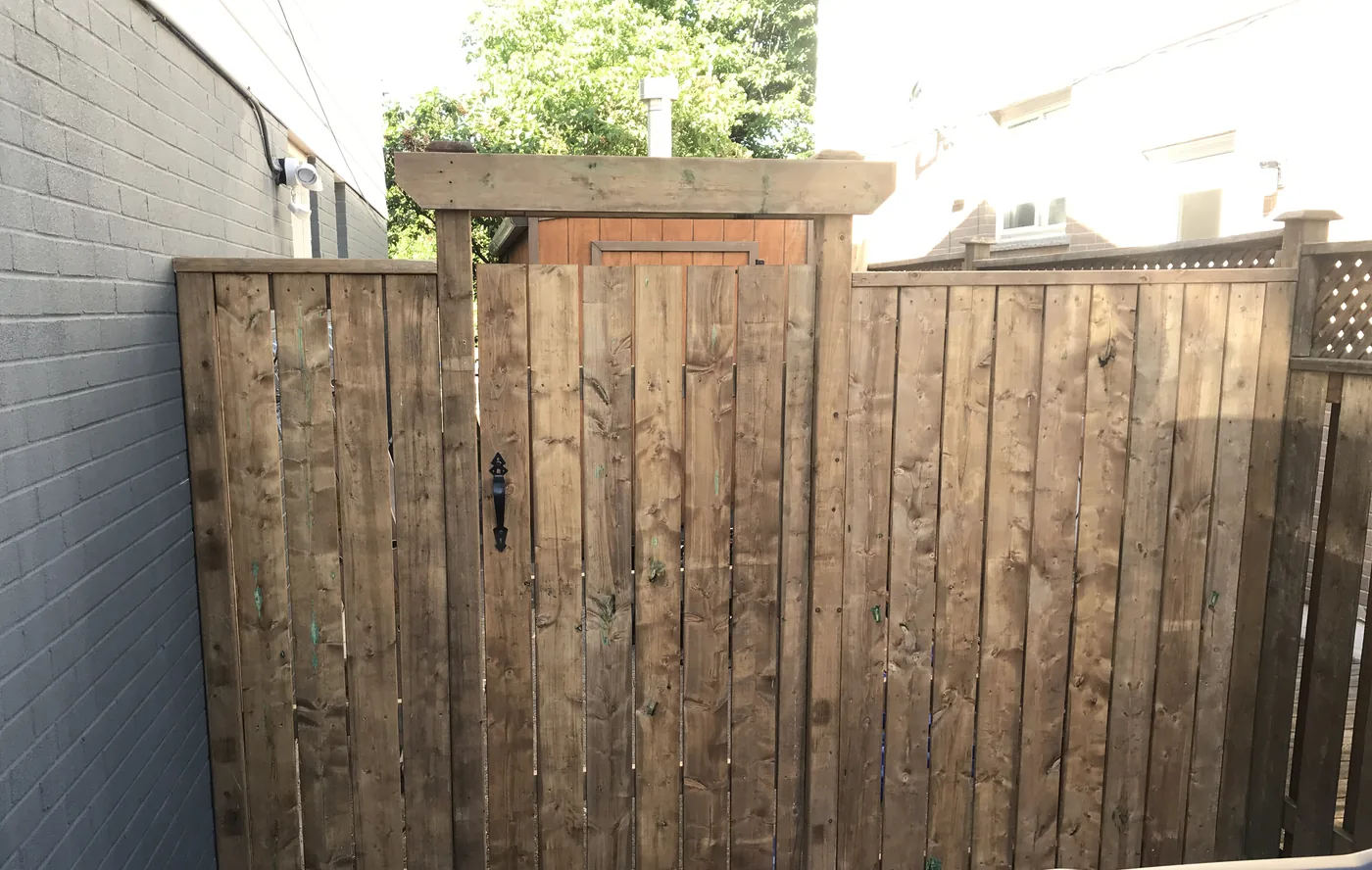
Why gates sag
A walk gate hangs all its weight off one post, from one edge. Every time it swings, that weight levers the top of the hinge post toward the opening. Over a few years, something gives:
- The hinge post: rotted just below the ground, set too shallow, or lifted by frost
- The hinges: too light for the gate, or held with short screws that have worked loose
- The gate frame: no diagonal brace, or a brace that runs the wrong way, so the gate racks out of square
- The hardware: screws and hinges on treated wood that have rusted through their coating
- The latch post: moved by frost, so the latch and the catch no longer meet
How to tell which one it is
You need a level, a tape measure and a screwdriver.
- Put the level on the hinge post. If it's off plumb, the post has moved
- Push the top of the hinge post hard. It shouldn't move at all
- Lift the latch end of the gate. If the latch lines up when you lift, the gate or its hinges have dropped
- Measure the gate's two diagonals, corner to corner. Equal means the gate is square. If they differ, it has racked
- Check every hinge screw. Loose screws, or screws spinning in soft wood, mean the hinge isn't holding
- Look along the bottom edge. Scrape marks on the ground, the pavers or the snow show where it drags
If the hinge post has moved
This is the usual cause, and the one people tend to fix last. A post that has rotted at the ground line or been lifted by frost won't hold a gate, however good the hinges are. A post that leans but is still sound can sometimes be dug out and reset deeper. A rotted post has to come out.
A replacement post goes into fresh concrete about 1.2 m (4 ft) deep, below the frost line, with the top of the concrete sloped so water runs off. The hinge post should be heavier than the line posts. On a fence and gates job in Toronto we used 6x6 posts set about 4 ft deep and hung the gates on them. New posts mean digging, so locates come first through Ontario Dig Authority (formerly Ontario One Call). Our leaning fence guide covers post failures in more detail.
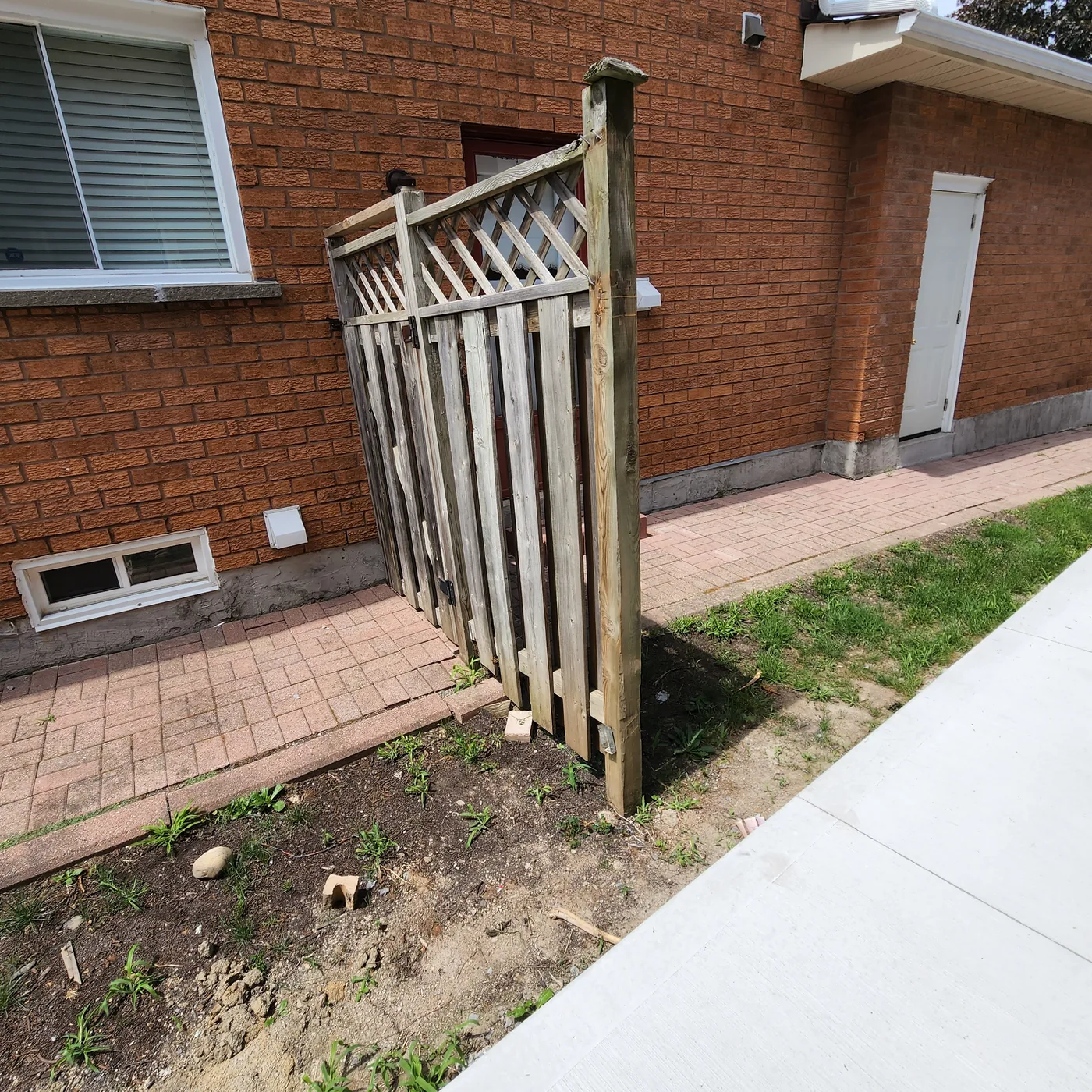
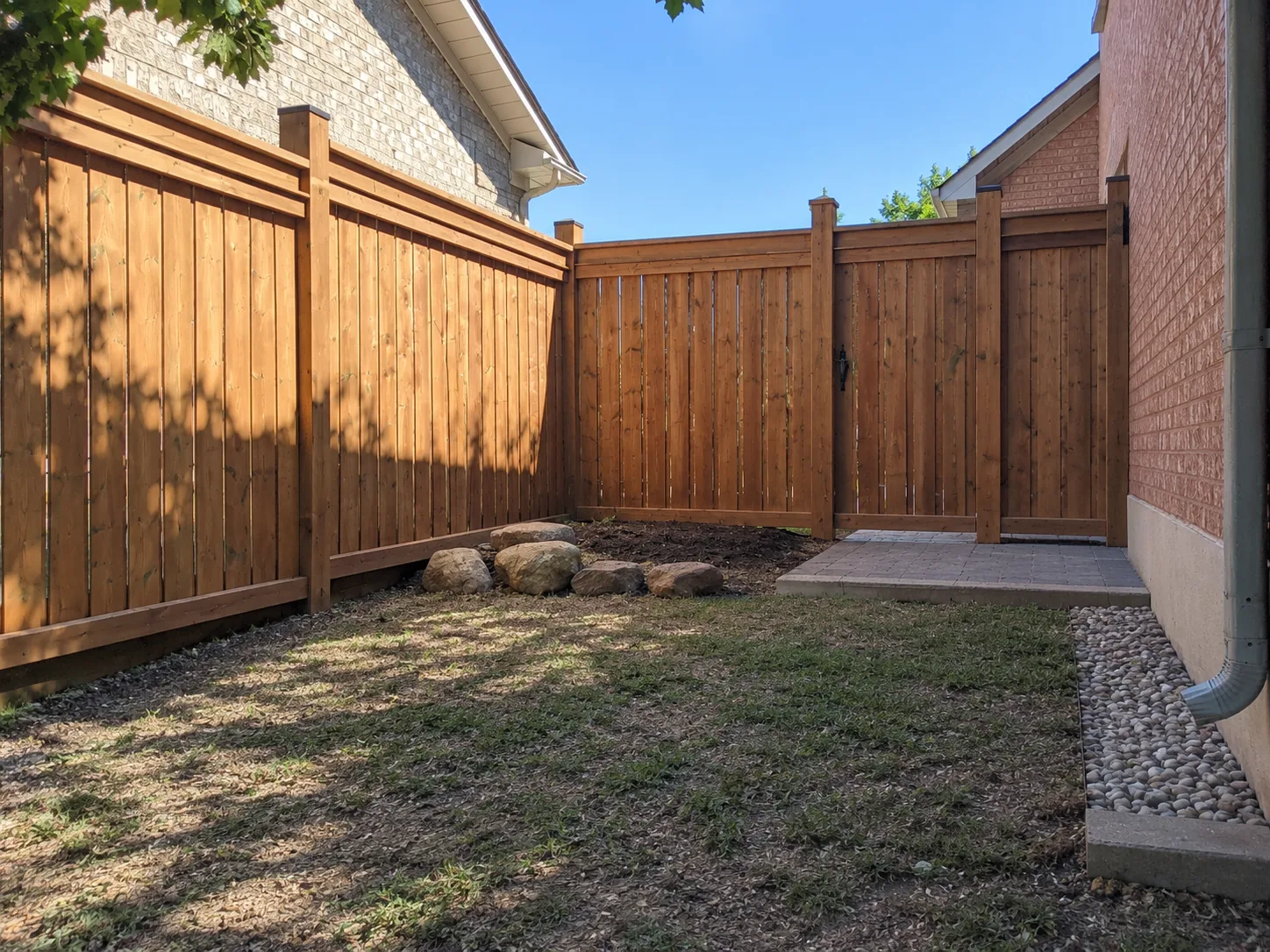
If the post is solid, fix the gate
Start by squaring the gate. Lift the latch end until the two diagonals measure the same, and hold it there with a block underneath.
Then brace it so it stays square. A wood brace runs from the bottom corner on the hinge side up to the top corner on the latch side, so it pushes the latch end up. Fitted the other way, the brace gets pulled instead of pushed, and the screws at its ends end up carrying the load. Steel cable kits run the opposite way. The instructions for Nationwide Industries' non-sag gate kit run the cable from the top of the hinge side down to the bottom of the latch side, and a turnbuckle takes out the sag. Either method keeps the gate square, and the cable can be tightened again later.
Hinges next. A gate should hang on hinges sized for its weight, with screws long enough to bite well into the gate frame and the post. On a heavy gate, bolts through the frame hold better than screws. On pressure-treated wood, use hot-dip galvanized or stainless steel hardware. The Canadian Wood Council warns that most copper-based preservatives corrode unprotected fasteners, and says red rust on galvanized hardware means the coating has failed.
Reset the latch last. Once the gate is square and hanging right, the catch usually needs moving to line up again. Moving the latch first only hides the sag until the gate drops a little more.
| What you see | Likely cause | Usual fix |
|---|---|---|
| Hinge post leans or rocks | Post rotted at the ground, set too shallow, or heaved | Reset or replace the post |
| Latch end drops, post is plumb | Gate racked out of square, no brace | Square it, add a brace or cable kit |
| Hinge screws loose or spinning | Hinges too light, or screws too short | Heavier hinges, longer screws or bolts |
| Binds on the latch post after rain | Boards swelled across their width | A bigger gap at the latch side |
| Sticks only in winter | Frost lifting a post or the ground under the gate | Reset the post deeper, or raise the gate |
| Gate frame soft or split | Rot in the gate itself | A new gate on the existing posts |
Gates that stick in fall and winter
Wood swells as it takes on water and shrinks as it dries, and nearly all of that movement is across the width of a board. Its length barely changes. An Oklahoma State University Extension fact sheet puts shrinkage across the grain at about 4% to 11% for the species it lists, from green wood to fully dry. Fence boards won't move that far in one season, but a few millimetres across a whole gate is enough to make it bind.
So leave a gap on the latch side when a gate is built or rehung. If a gate only sticks when it's wet, don't plane it down in October. You'll have a wide gap by next summer.
A gate that sticks once the ground freezes and frees up in spring usually has frost under it. Frost can lift a shallow post, or the pavers and soil under the gate's swing. Leave room for snow under the gate, keep the swing clear, and don't force a frozen gate open. If it happens every winter, the post likely needs resetting below the frost line. Our fall and winter fence guide explains how frost lifts posts.
Pool gates can't wait
A pool gate that sags and won't latch on its own is a safety problem. Toronto's Municipal Code Chapter 447 requires pool enclosure gates to be supported on substantial hinges, and to be self-closing with a lockable, self-latching device on the inside near the top. Every GTA city in our pool fence guide asks for a self-closing, self-latching gate. If yours doesn't swing shut and latch by itself every time, fix it before the pool opens again. If the whole enclosure is due, our pool fence page covers what a new one involves.
What it costs
Rehanging or bracing a gate is priced per job, because it depends on the gate and its hardware. When a post or the gate itself needs replacing, our fence cost guide has the ranges, installed and before HST:
- Fence post replacement, wood post set in concrete: $250 to $500 per post
- New walk gate: $300 to $1,200
- New double drive gate: $600 to $1,500
A new gate on a failing post will sag again, so if the hinge post is the problem, budget for the post first. On a wide opening, a double gate splits the width, so each leaf is lighter and puts less load on its post.
See our gates and fence repair pages, or send us photos of the gate closed, the hinge side and the bottom edge. We'll tell you whether it needs a post, a brace or a new gate.
Sources: City of Toronto, Municipal Code Chapter 447, Fences; Nationwide Industries, Non-sag gate kit for wood gates, installation steps; Canadian Wood Council, Fasteners; Oklahoma State University Extension, Dimensional changes in wood; Wood Preservation Canada, Above ground versus ground contact decay hazards; Ontario Dig Authority, Locates overview. Checked October 2026.
Keep reading
Deck cost guide
Installed prices per sq ft by material, plus railings and stairs.
Learn moreFence cost guide
Installed prices per linear foot by fence type, plus gates.
Learn moreBest fence for privacy
Which styles block the view, what they cost and how tall they can go.
Learn moreGlass vs aluminum railings
Cost, view, cleaning and inspection compared, and when to mix them.
Learn moreQuestions
Why is my fence gate sagging?
Which way should the diagonal brace go on a gate?
Why does my gate stick in winter?
How much does it cost to fix a sagging gate?
Tell us about your deck or fence
Send a few photos and rough measurements. We'll come back with next steps and a time to see the site.